- No.
- H-0534
- Fam.
- Potamogetonaceae
- Loc.
- Bjólfstjörn, Seyðisfjörður, Iceland
- Leg.
- Hallgrímur Steinsson, interpreter and translator, 14 February 1944
H-0534HerbariumPotamogetonaceae
Mother-Tongue Pondweed
Potamogeton mutuatus
ArchivedA pondweed above a wartime Icelandic signal station gave the town the weather of whatever language was last spoken over its water.
- Collected at
- Bjólfstjörn, Seyðisfjörður, Iceland
- Date
- 14 February 1944
- Collector
- Hallgrímur Steinsson, interpreter and translator
- Anomalies
- MeteorologicalLinguistic
Sequenced fragment
GGGCAATCCTGAGCCAAATCCTGTTTTCTCAAAACAAAGGTTCAAAAAACGAAAAAAAGAATATTAGGATAAGAATAAAAAAAGGATAGGTGCAGAGACTCAATGG
Contents 6 sections
Description
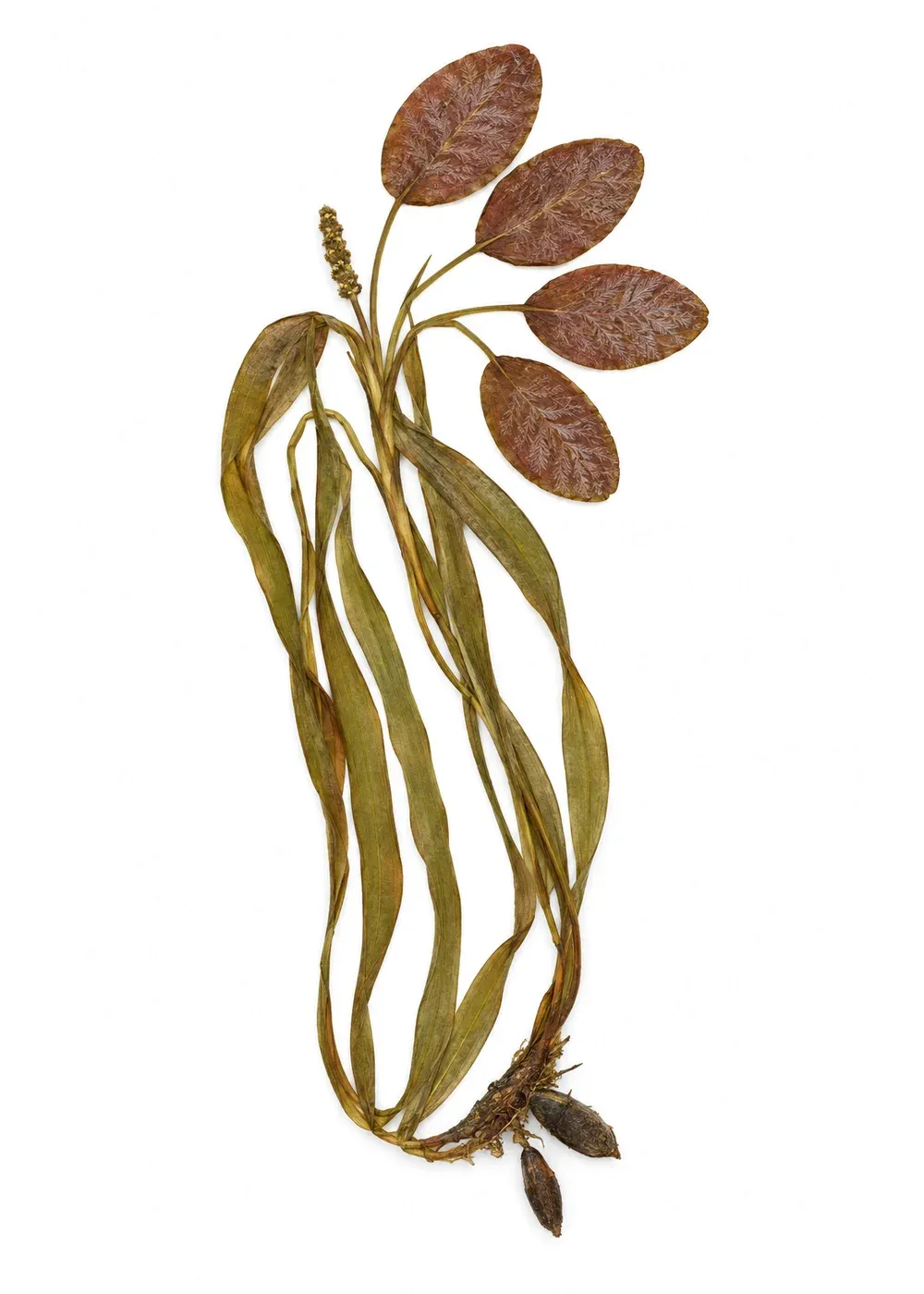
A perennial pondweed of cold, still, shallow water, held as one pressed shoot with its rhizome. The stem is 74 cm long and unbranched, folded three times. Submerged leaves are linear-lanceolate, 6–11 cm, thin and translucent, olive-brown as dried. The five floating leaves are elliptic, 4–6 cm and leathery, on petioles of 3–5 cm, and have dried a reddish bronze. A single emergent spike of 3 cm carries tight whorls of small four-parted flowers. Two club-shaped turions, each about 2 cm, are still attached at the rhizome.
Observations
While the plant was alive, the weather over Seyðisfjörður matched the weather at that moment in the homeland of the last language spoken aloud within about ten metres of the tarn.
- The change began within forty minutes and held until a different language was spoken there. Silence changed nothing.
- Cloud, rain, temperature and wind followed the source. Barometric pressure did not.
- Dialect counted. A Glasgow speaker brought Glasgow weather, not London weather.
- Icelandic gave the town its own weather back.
- The effect reached from the head of the fjord to about Brimnes, 9 km out.
The pressed specimen has shown no effect. It was tested in 1951 with readings in eleven languages.
The file
The tour script is taken from the collector’s written statement of 3 June 1946 and has been read to visitors unaltered since 1953. The advertisements were found by this office in bound runs of Icelandic newspapers. They are filed with the script in date order, each with what came of it.
Herbarium tour — East gallery
Guide’s script for the east gallery, stops 6–8, drawn from the collector’s statement. Kept by E. M. Fairlie, Registrar
Guides: allow four minutes. Read as written.
Stop 6 — Cabinet 14, the pondweed
This pondweed grew in Bjólfstjörn, a tarn on the slope above Seyðisfjörður in east Iceland. During the war the British ran a signal station just below it. The station’s interpreter, Mr Hallgrímur Steinsson, noticed that the town’s weather depended on the last language spoken over the water. Speak English with a Leeds accent and the town got that morning’s weather in Leeds. Speak Icelandic and it got its own weather back.
Stop 7 — The weather board
In August 1942 Sergeant Alexander Cairns of Govan inspected the fence round the tarn and told the work party at length what he thought of it. Seyðisfjörður had Glasgow drizzle for seven days. When the Glasgow papers reached the station, Mr Steinsson checked them: the same drizzle on the same seven days.
In the spring of 1943 a Faroese fisherman, Jóannes Hansen of Klaksvík, knelt at the tarn and prayed for his brother’s boat. The town had a clear Tórshavn sky until Sunday, when the minister’s wife went up to fetch her goat. (Pause. Groups usually laugh.)
Stop 8 — The spectacles
In the case beside the cabinet: a pair of tortoiseshell reading glasses with one lens cracked. Mr Steinsson gave them with the specimen and wore them to write its label. In his statement he says he had no further use for them.
If anyone asks
Why was it pressed? Mr Steinsson collected it on 14 February 1944, four days after German aircraft sank the tanker El Grillo in the fjord. He judged it should not be left above a military station.
Who else knew? The station’s men, and in time most of the town.
For anything further, refer the visitor to the Registrar.
Small ads — As filed by the Registrar
Classified advertisements from Icelandic newspapers, with outcomes. Compiled by E. M. Fairlie, Registrar
Copied exactly. The translations from Icelandic are this office’s.
Wanted — Danish books, any subject
Wanted: Danish books, any subject, any condition. Large type preferred. Postage paid. H. Steinsson, Signal Station, Seyðisfjörður. Reykjavík daily, 22 August 1942.
Eleven parcels arrived by December. Mr Steinsson kept one of them, Andersen’s tales in two volumes, large type, and gave the rest to the school. Margin: placed eight days after Sgt Cairns’s inspection.
Personal — Would the gentleman who reads
Would the gentleman who reads aloud at the upper tarn before seven kindly call at the Met. hut. No trouble meant. Cpl D. Ashworth. Seyðisfjörður weekly, 2 December 1942.
No reply is recorded. Corporal Ashworth’s log for November marks low overcast on the 4th, 19th and 27th as “against the barometer”. Margin: the harbour master’s book records ships entering the fjord on each of those mornings.
Lost — Reading glasses, tortoiseshell
Lost early on 10 February at the upper tarn: reading glasses, tortoiseshell, strong lenses. Reward. H. Steinsson. Seyðisfjörður weekly, 16 February 1944.
Found in the shallows on 2 June 1944 by Sigrún Ólafsdóttir, aged nine, with one lens cracked, and returned by hand. Margin: Met. hut log, 10 February 1944, 06.50: cloud nil, visibility over 40 km. Tórshavn station, the same morning: clear.
For sale — Andersen’s tales, Danish
For sale: H. C. Andersen, Eventyr og Historier, two volumes, large type, some water marks. 15 krónur. H. Steinsson. Seyðisfjörður weekly, 11 September 1946.
Bought by the school for 12 krónur. Margin: the statement from which the tour script is drawn is dated 3 June 1946. It runs to nine pages.
Genetic analysis
The specimen was sequenced in 2009 from 4 mg of floating-leaf tissue. The fragment comes from the plastid trnL intron, a standard barcode region, and its uppercase flanks are ordinary Potamogeton.
The reads divide at the lowercase stretch. A plant normally carries one plastid haplotype, inherited from its seed parent. This one carries three, in the same proportions across four extractions: 58% match a pondweed population at Furesø on Zealand, 27% one from a tarn above Tórshavn and 15% one from the Clyde at Bowling. None matches the Icelandic reference population from Lagarfljót, 60 km away. The plastome’s GC content is 36.5%, which is unremarkable.
Cultivation
Not cultivated. The collector pressed the whole shoot on the day he took it, and nothing has replaced it in Bjólfstjörn. A survey in August 1952 found water-starwort and crowfoot but no pondweed.
The two turions at the base are intact, and their weight and colour suggest they may still be viable. The Conservatory has not tried to germinate them. The registrar’s last memorandum on the subject, filed in 1987, raises one practical point and leaves it there: someone would have to speak first over the tray.
Effects
During the war the town learned to walk past Bjólfstjörn without speaking. Signallers settled arguments over weekend leave by sending the loser up with a phrase book. Washing went out or stayed in according to who had been seen on the tarn path. In March 1943 Corporal Ashworth gave up forecasting and logged only what he saw.
Mr Steinsson stayed on as harbour interpreter until 1958. He bought new glasses with the same prescription.
Since it was pressed, the plant has had no measurable effect. At Stop 7, visitors often say something to Cabinet 14 in their own language and then look at the gallery window. Guides are asked not to encourage this. The weather in the east gallery has been logged since 1951 and has always matched the street outside.
Filed alongside
Shubin's Ribbon
Laminaria famae
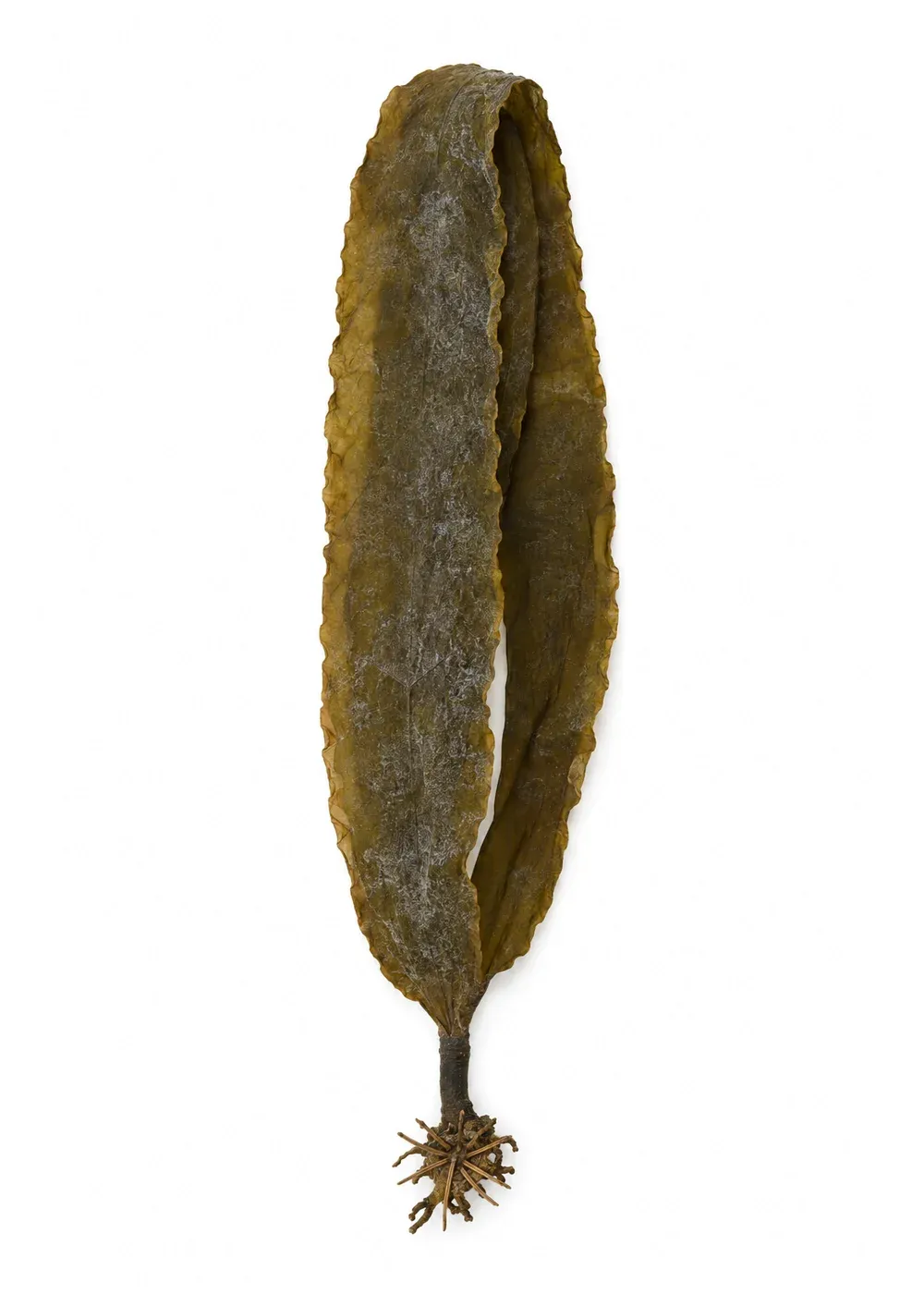
A kelp found in Siberian larch forest in 1887, and an auctioneer who acquired a limp the same week he wrote to deny it.
Expected-Value Indigo
Amorpha fruticosa
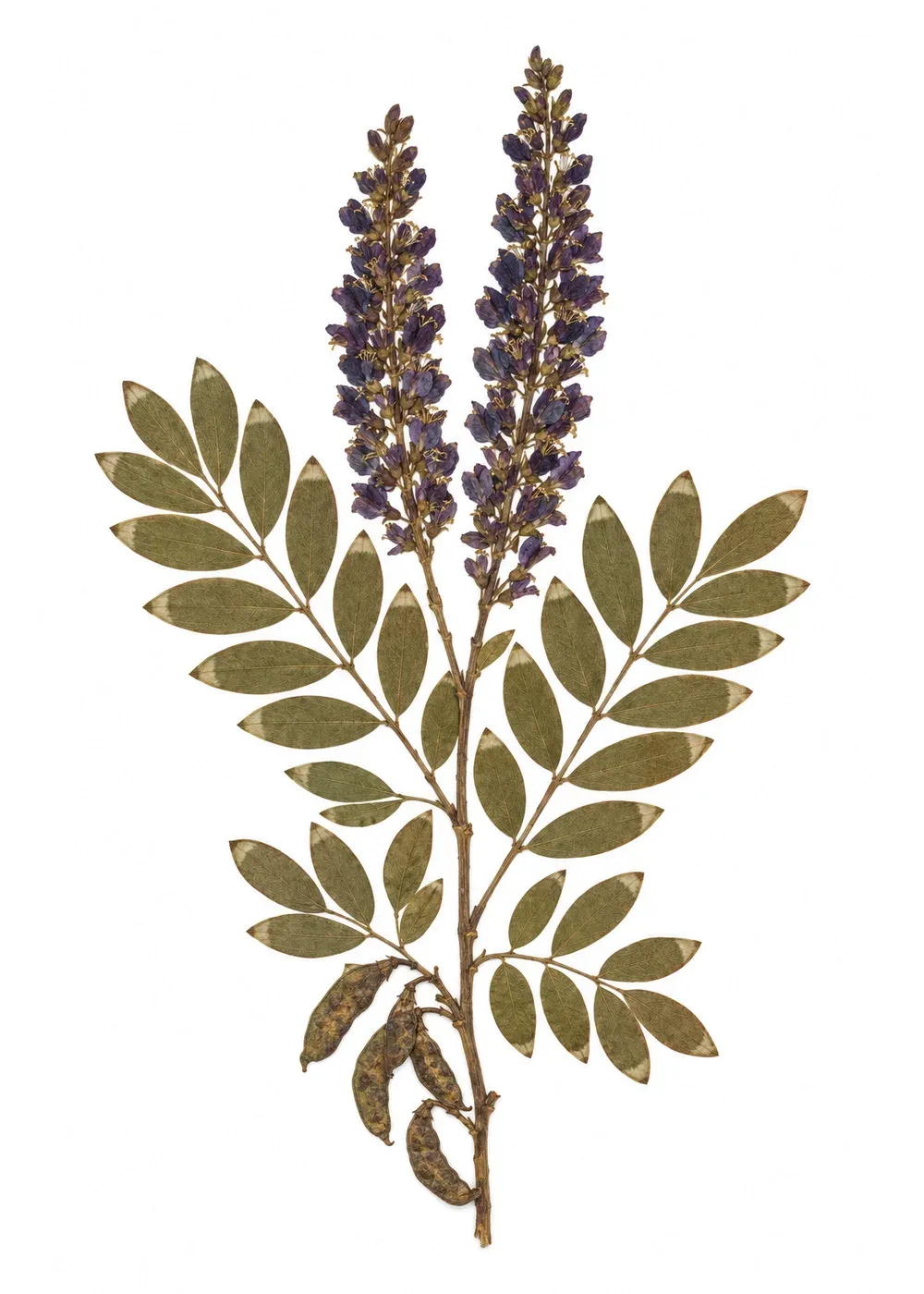
A false indigo pressed in 1915 keeps the sky over it at the average: 0.14 inches of rain a day at Yazoo City for seventy-six years.
Calicut Noon
Dioscorea meridiana
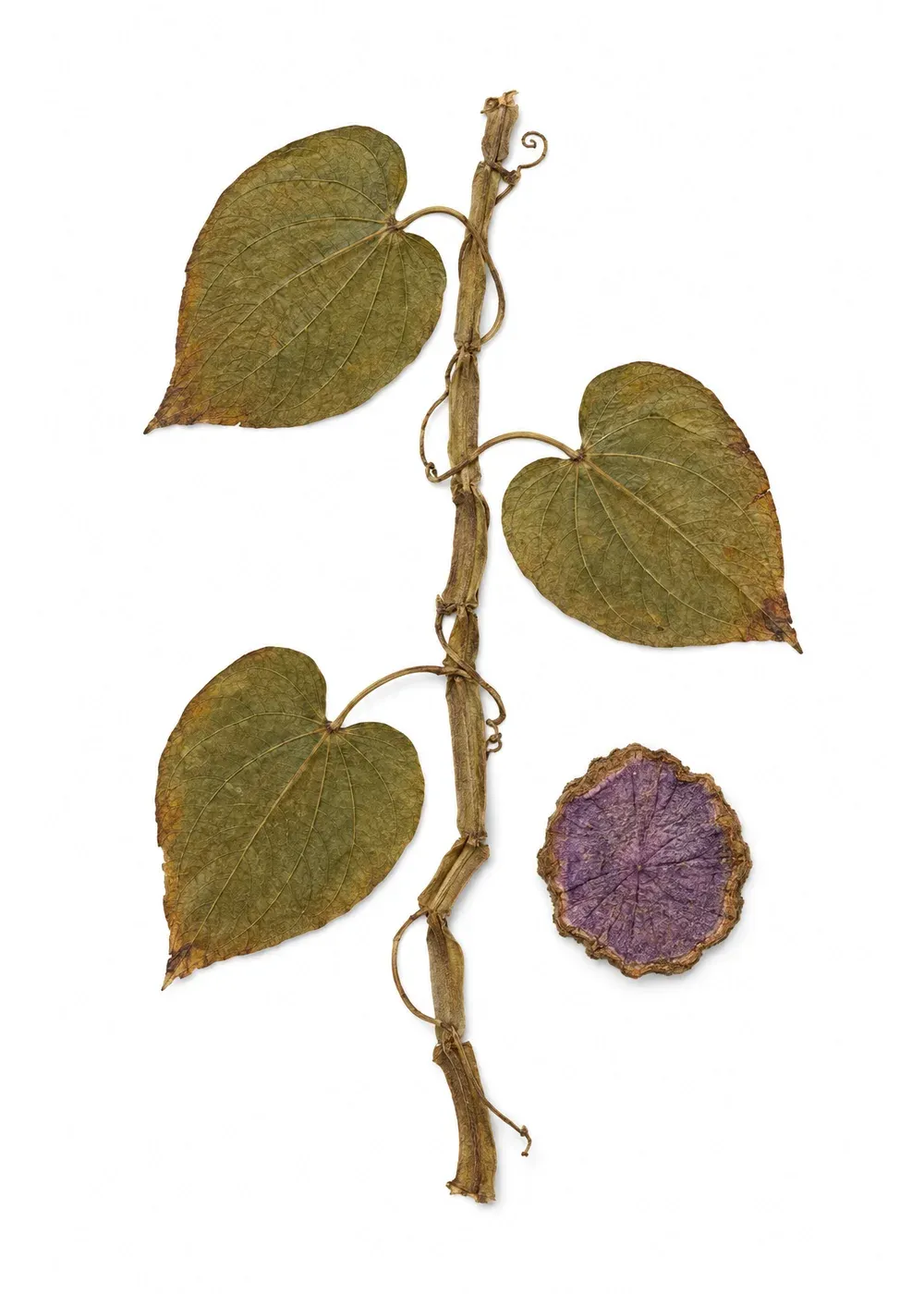
In a Leeds curry house, everything near this yam cast the shadow of the sun over Kozhikode, and the cook rang home by the salt cellar.