- No.
- H-0533
- Fam.
- Conocephalaceae
- Loc.
- Utne, Hardangerfjord, Norway
- Leg.
- Solveig Tufte, ship's cook, April 1988
H-0533HerbariumConocephalaceae
Maker's-Hour Liverwort
Conocephalum horarium
ArchivedA Hardanger liverwort pulls every nearby clock to the local time of the town that made it, and a court once rebuilt a ship's galley from nine of them.
- Collected at
- Utne, Hardangerfjord, Norway
- Date
- April 1988
- Collector
- Solveig Tufte, ship's cook
- Anomalies
- Temporal
Sequenced fragment
ATGGCTCAAGAGCTTCGTGAAGGACGACGACGACGACGACGACGACGACGACGACGACGTCGACGACGACGACGACGACGACGACGACGACGACCCTTGGAAGTTCAAGGACTG
Contents 6 sections
Description
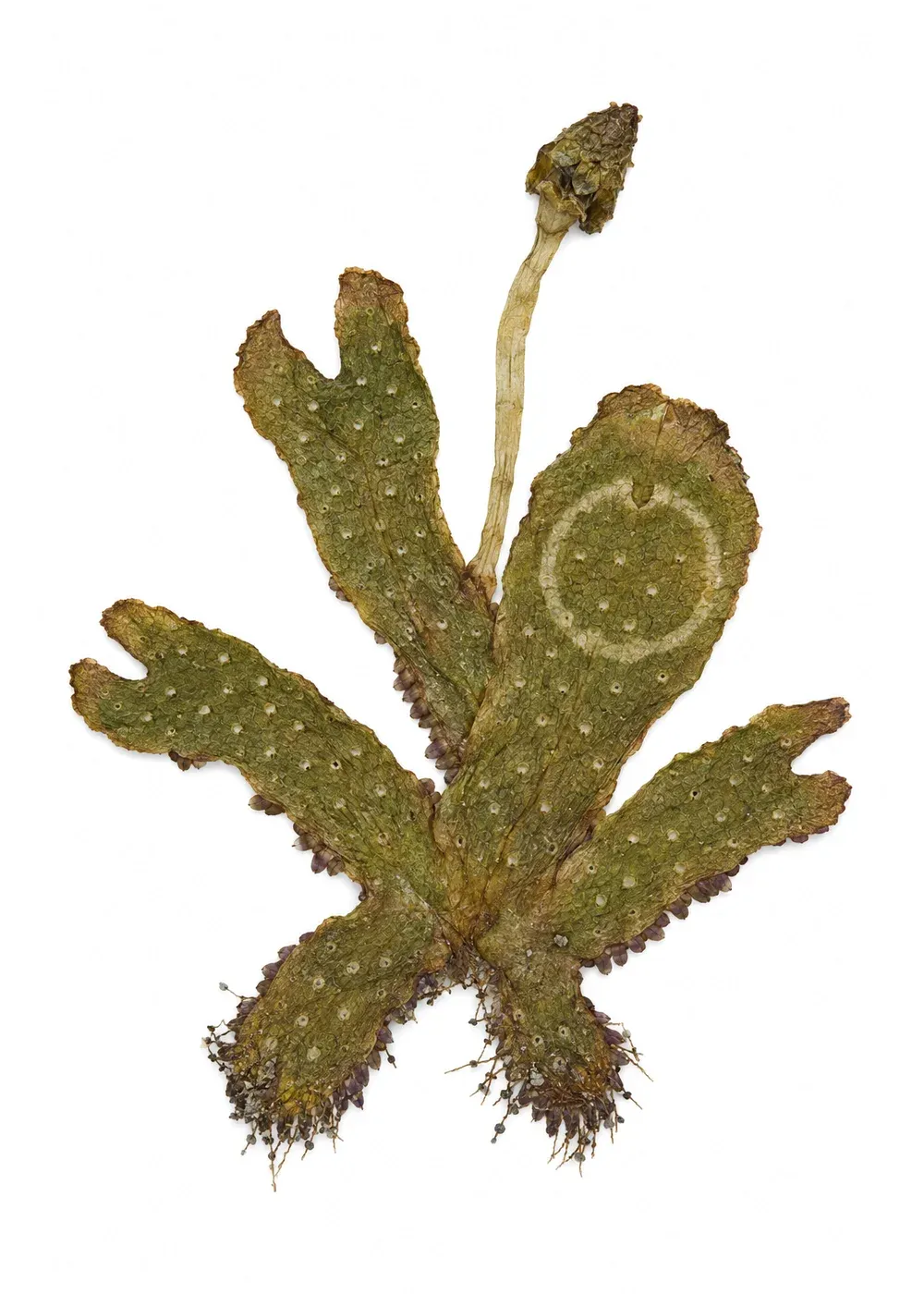
A thalloid liverwort pressed as a single mat 7 × 5 cm. It has four lobes, forked into two again and again, each 8–12 mm wide with slightly wavy margins. The upper surface is divided into conspicuous hexagonal areolae, and each one has a pale central pore. The underside has purple-brown ventral scales and dense smooth rhizoids with some grit stuck to them. One lobe bears a conical female receptacle 9 mm tall on a translucent stalk 4 cm long, which collapsed in pressing. Dried colour is olive to brownish green. When the folder is first opened the thallus smells faintly of turpentine, as its genus does.
Observations
Clocks and watches kept near the living plant drift until they show the civil local time of the place where they were made. Then they stop drifting and keep that time exactly.
Drift
The drift is steady and makes no sound. At 10 cm a clock moves by an hour in about an hour. At 2 m the same hour takes about a week. Nothing has been measured beyond 3 m. Mechanical, electric and quartz movements are all affected; sundials and hourglasses are not. Once a timepiece has reached its maker’s hour, it also follows the maker’s summer-time changes. An Osaka timer kept beside the plant in Hardanger ran eight hours fast through the winter of 1988 and seven hours fast the following summer.
Place of manufacture
What counts is where the timepiece was finally assembled, not where its movement came from: a Swiss movement cased in Hong Kong goes to Hong Kong time. A clock of unknown origin will show one. The Conservatory has used this twice to settle a provenance and once to unsettle one.
Pressed material
The specimen was pressed when it was accessioned in 2002 and still has about a third of its effect. The pale ring on the broadest lobe is where a wristwatch was laid face-down on the living thallus in the Aberdeen saleroom. Staff leave their watches in a tray at the Herbarium door.
The file
Alan Duthie put this file together between 1991 and 2002. He was a clerk at an Aberdeen saleroom, where the fittings of the Norwegian motor vessel Kvitholm came for sale in March 1991. Lot 212 was nine timepieces, with sundries. On the viewing day the nine showed nine different times. Mr Duthie withdrew the lot. He had the record of a hearing at the Norheimsund district court translated, and spent eleven years finding the owners. His notes appear in square brackets.
Exhibits in the matter of the Kvitholm
Exhibits and ruling in the growers’ claim against the owners of MS Kvitholm, translated by I. Reid, annotated by A. Duthie, saleroom clerk
Exhibit A — The enamel dish
A white enamel pie dish, 22 cm, chipped, holding a liverwort on a slab of wet stone. The cook, Solveig Tufte, took it from the culvert below the Utne ferry quay in April and kept it above the galley stove. On the morning of the sailing it was on the mess porthole shelf, 28 cm from Exhibit B.
[212(a). Condition fair. Contents alive, though you would not think it.]
Exhibit B — The mess clock
A brass bulkhead clock with an eight-day movement, made in Birmingham. It was taken down at 09:40 and found to be 60 minutes slow. The crew woke, ate and sailed by it. The vessel was due to sail at 06:00 and let go at 07:01. She reached Bergen after the buyer’s lorry had gone, and 1,140 cases of apples were refused.
[212(b). Returned to Capt. O. Lekve, Utne, who asked whether he might keep it an hour slow. He might.]
Exhibit C — The galley timer
An electric kitchen timer with a clock face, made in Osaka. Eight hours fast. A strip of tape across the face reads “−8” in the cook’s hand.
[212(c). The tape is original and has not been removed.]
Exhibit D — The luggage label
A buff card label, found tied to the handle of Exhibit A. One side has a name and an Utne address. The other reads, in pencil, Han treng lys.
[212(d). Not for sale. The name side is folded under. I have not unfolded it.]
Statement of the watchmaker
Knut Aga, watchmaker, Norheimsund. I was given the nine timepieces, the town where each was made, and the time each showed at 09:40. I was not shown the vessel. From how far each had moved towards its own town’s time, I worked out where each had hung and where the dish had stood, and drew it. Laid over the owners’ plan of the galley, eight clocks fell within a hand’s width of their hooks. The dish was not on the stove shelf. It was on the porthole shelf, beside the Birmingham clock. The same week I had the master’s watch on my bench for a new glass. It was made in Neuchâtel. It would have been right.
Ruling of the bench
The vessel sailed 61 minutes late because the mess clock was 60 minutes slow, and the clock was slow because of Exhibit A. The court accepts Mr Aga’s evidence without claiming to understand it. No one aboard acted unreasonably on the clock in front of them. The decision does not depend on who moved the dish, and the court does not decide it. The name on Exhibit D is struck from the record. The claim is dismissed, and each party bears its own costs. The court notes that the apples were sold next day at Norheimsund, for juice.
[I have kept every exhibit that cleared somebody. There was no exhibit that did not.]
Notes on the Norheimsund court record
Notes on the court record by Ingrid Reid, translator, Aberdeen, for A. Duthie
Note 1 — On the word “byssa”
The galley. On the Kvitholm galley and mess were one compartment, and the record uses byssa for both. So have I.
Note 2 — On “klokka seks”
Six o’clock; literally, “the clock six”. Counsel for the growers asked the mate four times when it had been klokka seks. I have put it as “when was it six?”, which loses his point: by which clock.
Note 3 — An erased line
Page 6, line 14, is struck through in ink and initialled O.K.R. A two-word name can still be read underneath. I have not transcribed it. Mr Duthie asked me not to before I had thought to ask him.
Note 4 — On “Han treng lys”
Nynorsk. Levermose is masculine, so the plant is han, “he”. I have given it in the exhibits as “It needs light”. It reads more like a note for someone who would be back in the morning.
Translator’s afterword
I was asked for eleven pages and have translated twelve. The twelfth is the receipt for the juice: 1,140 cases, 4,560 kroner. Mr Duthie wished to keep it.
Complaints register, H-0533
Complaints received by the Conservatory about H-0533, with replies drafted by A. Duthie, volunteer
Ref. 3107 — An hour fast
A visitor’s wristwatch gained 52 minutes while she drew the specimen in the reading room.
Reply: Your watch is returned, reset. It was assembled in Neuchâtel, where it was already an hour later. It had only gone home for the afternoon.
Ref. 3119 — A missed train
A visitor missed the 17:12 to Inverness. His pocket watch had lost forty minutes in the reading room, on its way to losing five hours.
Reply: Your fare of £23.40 is refunded. Your watch was made in Waterbury, Connecticut, which neither of us knew. It was your grandfather’s, and he always said it was made in Coventry.
Ref. 3140 — The name on the label
A letter from Utne, in English. The writer says he moved the dish, that the catalog should say so, and that he was sixteen and is not ashamed of it.
Reply: We know, and the court knew. It left your name out on purpose, and so have I. If you write a second time, I will unfold the label. Until then I would like, if you will let me, to keep it folded.
[No second letter is on file.]
Cross-examination of Solveig Tufte, cook
The cook’s testimony, from the Norheimsund record, translated by I. Reid, kept by A. Duthie
Cross-examination by advokat Skeie
Q. You brought the plant aboard. — A. From the culvert under the quay at Utne. It was green in April, when nothing else was.
Q. You knew it did something to clocks. — A. To the timer. I put tape on it.
Q. You were ashore that night. — A. At my mother’s. My alarm clock was with me, and it was right.
Q. Then who moved the dish? — A. Someone who thought it needed light.
Q. That is not a name. — A. No.
Questions from the bench
The witness will not be asked to guess.
Q. How did you know the timer came from Osaka? — A. It says so underneath. I did not know where Osaka was until the timer was eight hours fast. Then I looked in the deckhand’s school atlas, and it was eight hours away.
Re-examination by advokat Hope
Q. What will you do with the plant? — A. Leave it where it is. It gets the light there.
Q. And the clock? — A. We can move the clock.
[The mess clock was moved to the wheelhouse. The dish stayed on the porthole shelf until the vessel was stripped in Aberdeen.]
Genetic analysis
Sequenced from the pressed thallus in 2003. The genome is ordinary for Conocephalum except at one locus. That locus is an ortholog of the PSEUDO-RESPONSE REGULATOR genes, which are part of the circadian clock in liverworts, as they are in flowering plants.
The array
A 72-base tandem array is inserted in the first exon. It is made of twenty-four three-base units: twenty-three of them GAC and one GTC. The array is exactly two-thirds GC. If unit 1 is counted as UTC−11, the variant at unit 13 falls on UTC+1, which is standard time at Utne.
Repeat readings
Samples taken in Aberdeen, in the reading room, and from a fragment carried to Osaka and back in 2007 have all put the variant at unit 13. The plant itself does not drift.
Cultivation
Not cultivated. The pressed thallus is kept in the east cabinet of the Herbarium, in a drawer with no timepiece within three metres. Its relatives grow readily on wet, shaded rock, and a fragment this size would probably regenerate. The Conservatory has not tried.
The culvert at Utne was relined in concrete in 1992. Mr Duthie searched the stream above it in 1994. He found only common Conocephalum conicum, which leaves clocks alone.
Effects
Every timepiece nearby is pulled to the time of the town that made it, and stays there until someone resets it. On people the effect is mostly administrative. The Kvitholm’s crew learned to subtract.
In Aberdeen, nine clocks showing nine times led one saleroom clerk into eleven years of letters. In the end he returned seven clocks to owners in Hardanger and Bergen who had not expected to see them again.
Visitors to the reading room tend to ask afterwards where their watches were made. About one in five finds the answer is not the one they were told.
Filed alongside
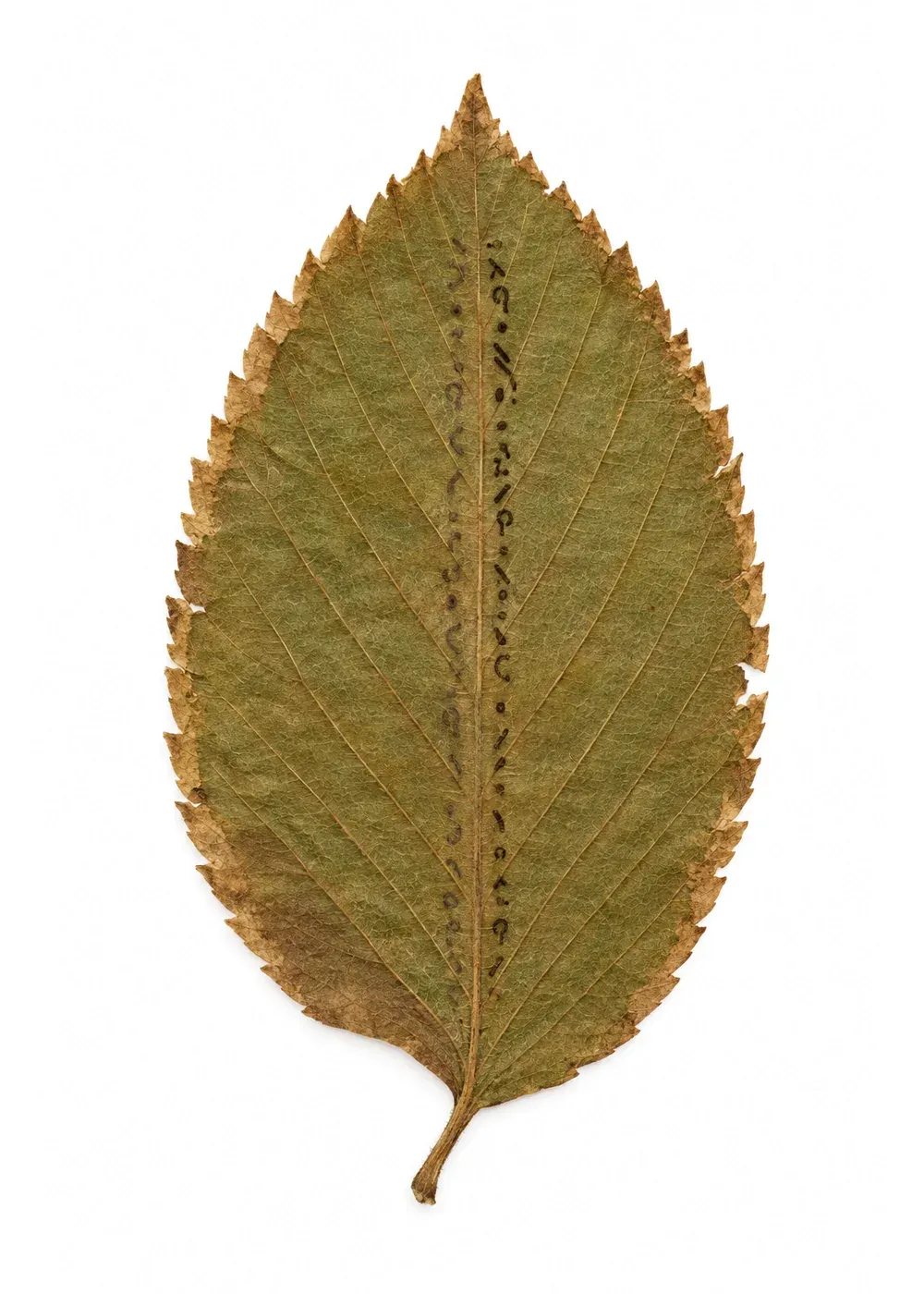
Hollow Elm
Ulmus testamenta
An elm whose growth rings record the last words spoken near it each year — and which has started recording words that have not been spoken yet.
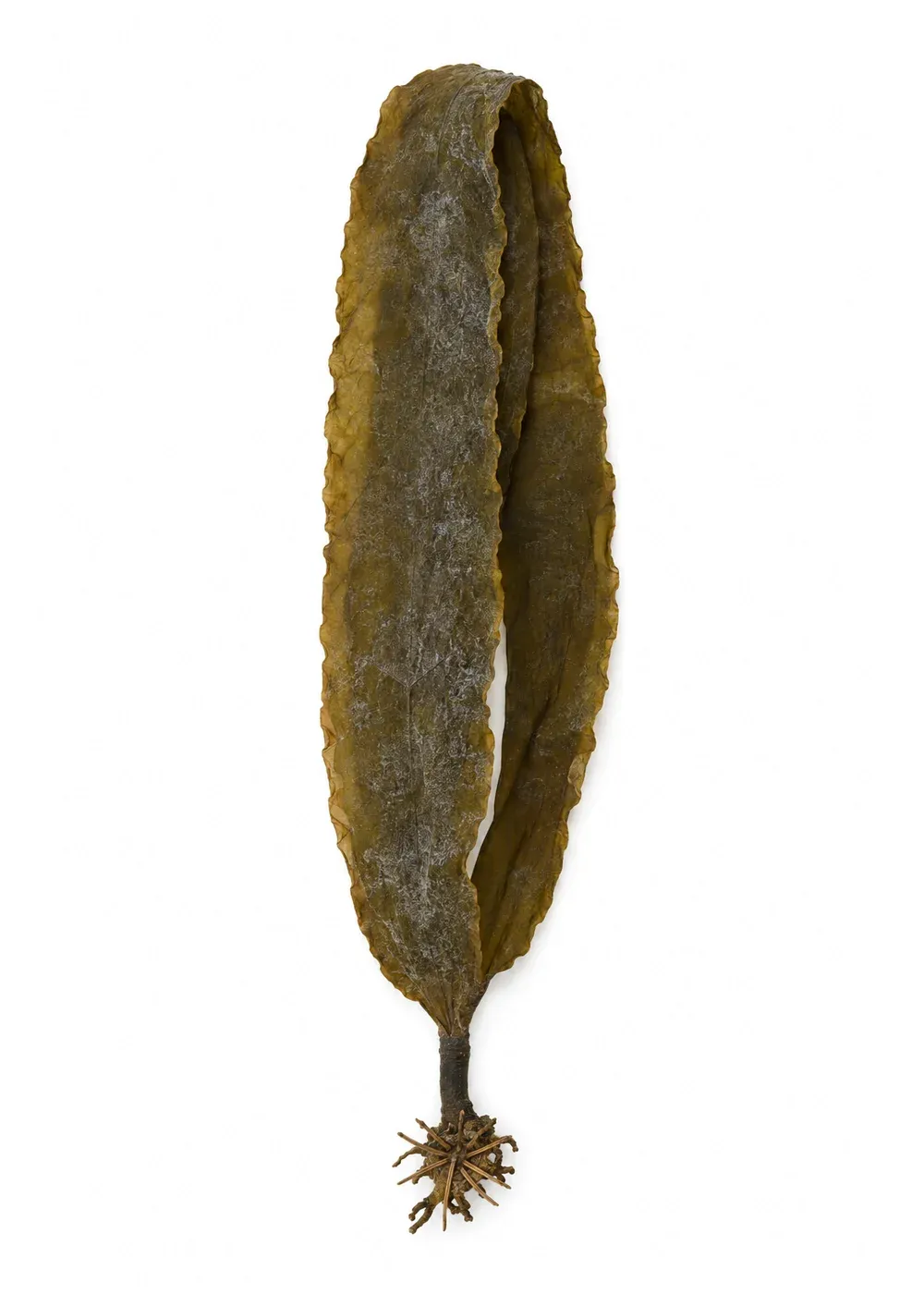
Shubin's Ribbon
Laminaria famae
A kelp found in Siberian larch forest in 1887, and an auctioneer who acquired a limp the same week he wrote to deny it.
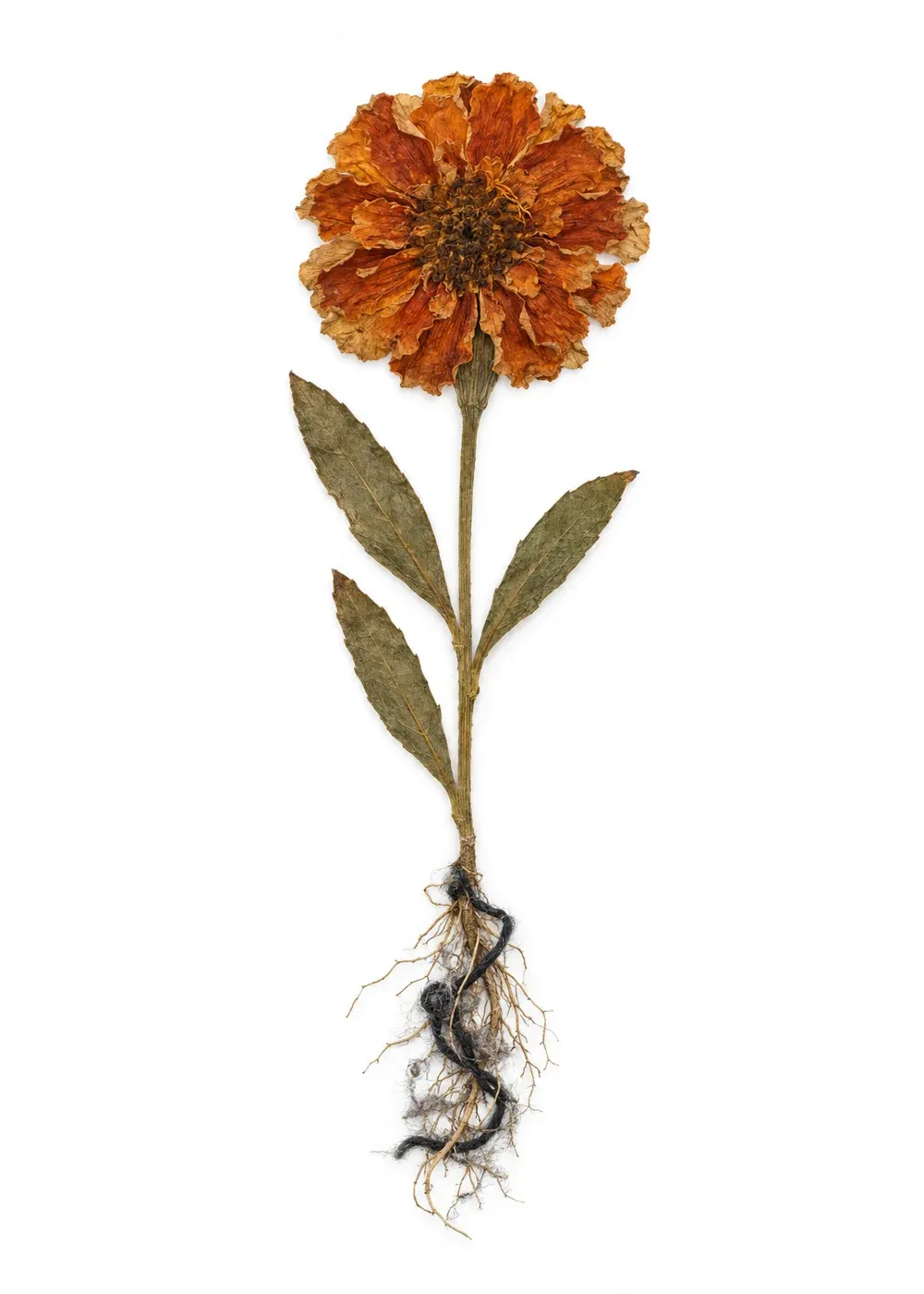
Funeral Laughter
Calendula hilarans
A marigold that sprouts only at funerals and makes the mourners remember something funny about the dead.