- No.
- G-0210
- Fam.
- Dioscoreaceae
- Loc.
- Kallai, Calicut
- Leg.
- Walter Ibbotson, survey cartographer, February 1884
G-0210GlasshouseDioscoreaceae
Calicut Noon
Dioscorea meridiana
Under cultivationIn a Leeds curry house, everything near this yam cast the shadow of the sun over Kozhikode, and the cook rang home by the salt cellar.
- Collected at
- Kallai, Calicut
- Date
- February 1884
- Collector
- Walter Ibbotson, survey cartographer
- Anomalies
- GeometricTemporalMeteorological
Sequenced fragment
ATGGCTTCTTCAAGAGGAACCATTGCTTCAAATCTGAAGCTAAAATATCTAACCACAAAATATCTGGTTTCAGTCAACCATGGAGAAGCTTTCAG
Contents 6 sections
Description
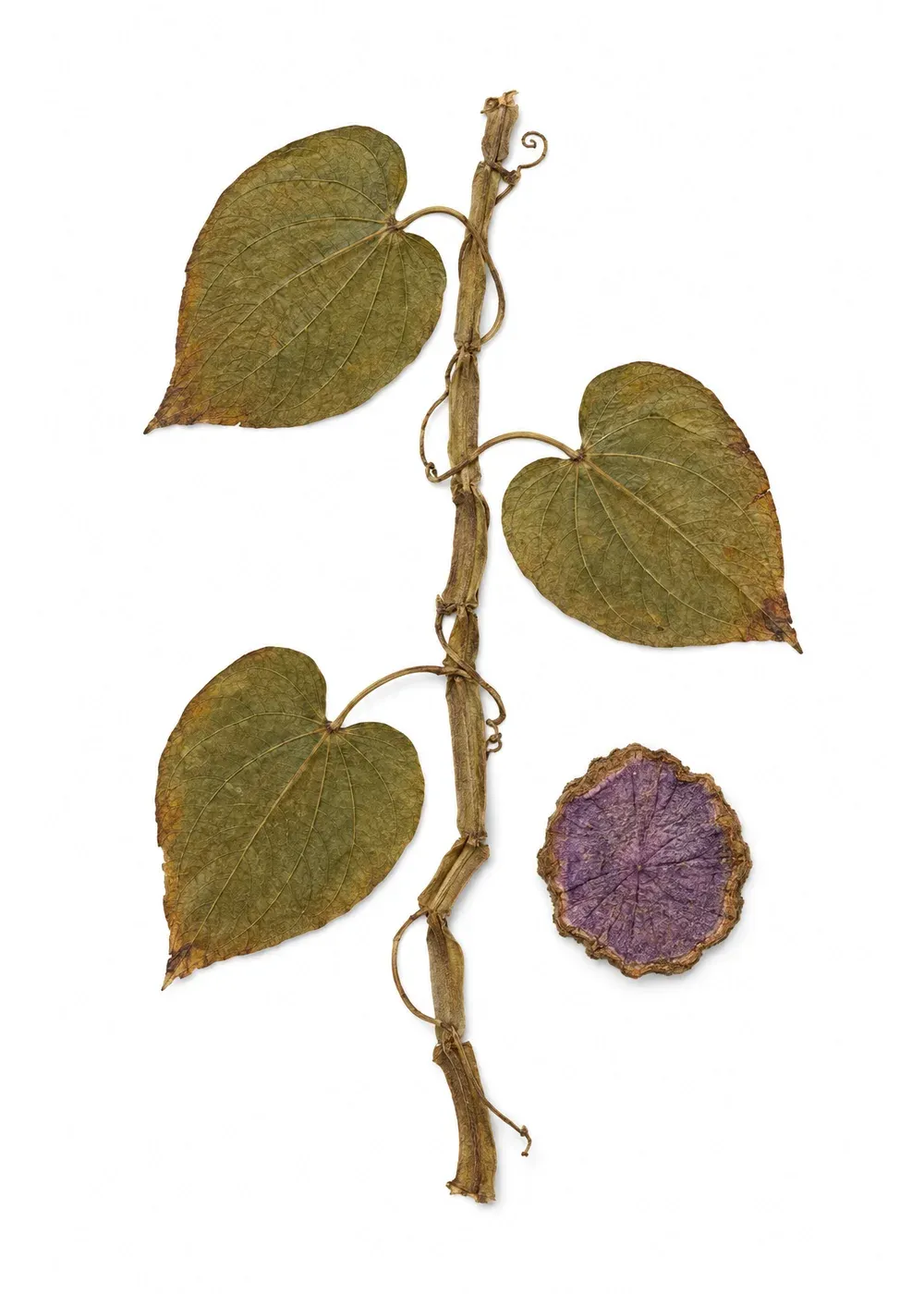
A single tuber of greater yam, 24 cm long and about 1.3 kg, cylindrical with a blunt crown. The skin is dark brown, corky and rootletted; cut surfaces are pale violet. Each spring it sends up one four-winged twining stem to about 3 m, with opposite heart-shaped leaves 8–12 cm long. The stem dies back in November. The tuber is kept in a 30 cm terracotta pot, with a plated salt cellar on the bench beside it.
Observations
Within 2.4 m of the tuber, objects cast no shadow from any local light. Each casts one shadow only, at the length and bearing it would have under the sun over Kozhikode (11.25° N, 75.78° E) at that moment. Bearings agree with calculated solar positions to within one degree. No light arrives; only the shadow.
Solar noon in Kozhikode falls at about 06:57 GMT. After sunset there, nothing within the radius casts a shadow at all, even under a directed lamp. The shadows thin when there is cloud over Kozhikode and are mostly absent during the south-west monsoon. Around 22 April and 20 August, when the sun passes directly overhead there, they shrink to nothing at noon. The tuber obeys the same rule, and the effect persists through dormancy.
The file
This file was put together by Janice Hirst, who cleaned the Kallai Kitchen on Roundhay Road, Harehills, Leeds, from seven to ten each morning. She sent it to us with the pot, the salt cellar and our deposit form, which she had signed as the owner’s representative. She was not the owner’s representative, and the owner has not answered our letters. The tuber came to the restaurant in a box of house-clearance crockery from Chapel Allerton, with a card reading Kallai, Calicut. Feb. 1884. W. Ibbotson, Survey. The salt cellar was in the same box.
Kallai Kitchen — menu
Lunch and evening menu of the Kallai Kitchen, Leeds, with the cook’s pencil notes — kept by Janice Hirst, morning cleaner
Home cooking from Kerala and Malabar. Lunch 12–2.30, evening 5.30–11, closed Mondays. Pencil notes are in M. Valappil’s hand. The margins are mine. — J.H.
To begin
Parippu vada, two to a portion. Kallummakkaya: mussels fried in rice flour and chilli.
Pencil: Not table 4 at lunch. After one o’clock the glasses there throw long shadows down the room, all towards the door. People keep moving their glasses.
From the kitchen
Kozhikode chicken biryani, Fridays only. Kaachil curry: purple yam with coconut and green chilli.
Pencil: Yam from Kirkgate Market. Not from the windowsill.
A note on table 4
Table 4 is not available for evening bookings.
Margin: After about two in the afternoon nothing on table 4 has a shadow. Not the candle, not the cruets, not your hand. Mr Kurian says it upsets people. It does.
To finish
Calicut halwa, black or red. Sulaimani: black tea with lime and cardamom.
Pencil: The clock over the pass is Leeds. The clock by the hatch is Kerala. The salt cellar is Kallai, twenty-seven minutes behind the hatch, because the sun does not keep government time.
Not on the menu
Pencil, on the back:
Sreelakshmi, Palayam stand – Kallai bridge – Feroke
- Palayam 10.40 · Kallai 11.02 · Feroke 11.30
- Palayam 12.50 · Kallai 13.12 · Feroke 13.40
- Palayam 15.15 · Kallai 15.37 · Feroke 16.05
Amma takes the 12.50 home with the fish. Off at Kallai 13.12, then ten minutes to the house. Ring when the salt cellar’s shadow touches this month’s line. There is no line for June or July because there is nothing to draw round. No shadow means rain at home. In rain the Sreelakshmi runs twenty minutes late, so use the hatch clock and add twenty.
Margin: Ten to nine in summer, ten to eight in winter. He only looked at a clock when the shadow had gone. There are ten pencil lines on table 4. I wipe round them.
Lost property — Kallai Kitchen
Lost-property book kept under the till at the Kallai Kitchen; pages copied out by Janice Hirst
Printed inside the cover: Entries to be made by the duty manager only. Items unclaimed after 28 days will be disposed of.
Item 0406 — One scarf, green wool
Found under table 2. Entered J. Kurian. Claimed the following Saturday.
Item 0409 — A pot of soil, table 4
Handed in at the till at 8.20 pm by a diner, who said his candle had no shadow and it must be the plant. Entered J. Kurian. Kitchen says the pot belongs to the restaurant. Returned to the windowsill.
Item 0415 — The same pot
Handed in at lunch by a party of six who had changed tables twice. Entered J. Kurian. Not to go back in the dining room. Kitchen to claim within 28 days or it will be disposed of.
Item 0427 — The same pot
Found by the bins in the back yard at 7.05 am, bin day. Entered J. Hirst, duty manager. Returned to the kitchen windowsill.
Margin: Day 29 was yesterday. A new number starts the 28 days again.
Item 0441 — The same pot
Found on the kitchen windowsill. Entered J. Hirst, duty manager.
Margin: Every 28 days. Mr Kurian only reads the cover.
Item 0468 — The same pot, and the salt cellar
Handed in by M. Valappil, cook, on his last morning. He is going home to Kallai and will not claim it. He says he won’t need it, because he’ll have the real one. Disposal: sent to the Conservatory, with the menu. Entered J. Hirst, duty manager.
Margin: I’m not. Somebody had to sign.
Genetic analysis
The fragment comes from the promoter of the tuber’s LHY-like clock gene. The flanking sequence matches Dioscorea alata at 98.6%. The lowercase stretch is a 24-base insertion made of three real plant clock motifs end to end: an evening element (AAAATATCT), a morning element (AACCAC) and a second evening element. No other plant on record arranges them this way.
Over 41 runs, the insertion read cleanly only in runs started while the sun was up over Kozhikode. Runs started after sunset there returned X at all 24 positions, with clean reads on either side. Runs started on monsoon days returned the insertion with falling quality scores. Moving the sequencer to another building made no difference.
Cultivation
The tuber grows on a bench in the tropical house at 24–28 °C, in free-draining loam. It is watered from April, when the shoot appears, and kept dry from November. Otherwise it is an ordinary greater yam.
Nothing else stands within 2.4 m of the bench, so that no neighbour loses its afternoon shadows. Mr Valappil once cut a minisett from it in the restaurant kitchen. That piece grows normally, casts ordinary Leeds shadows and lives in the staff canteen. The tuber has not been cut again. The salt cellar stays on the bench, empty.
Effects
In the restaurant, the tuber cost table 4 its evening bookings. For eleven years it also gave Mr Valappil a clock and a weather report from Kallai, without the telephone.
In the Glasshouse, its bench is the only place where visitors’ hands lose their shadows after lunch. Most visitors notice. Few say anything.
Each June a gardener writes to Mr Valappil in Kallai to tell him which morning the shadows on the bench went faint. He writes back with the day the monsoon reached Kallai. For four years running it has been the same day.
Filed alongside
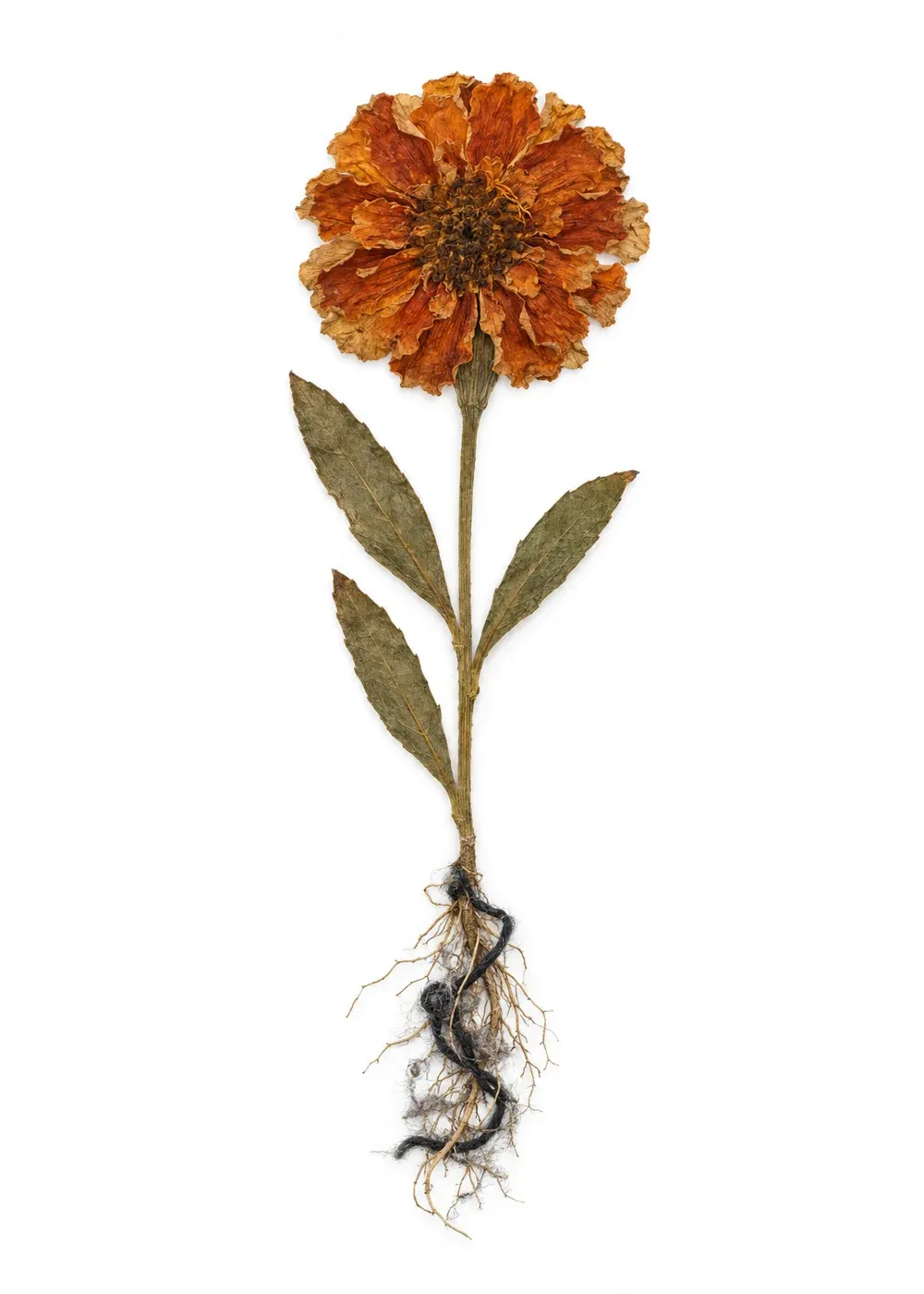
Funeral Laughter
Calendula hilarans
A marigold that sprouts only at funerals and makes the mourners remember something funny about the dead.
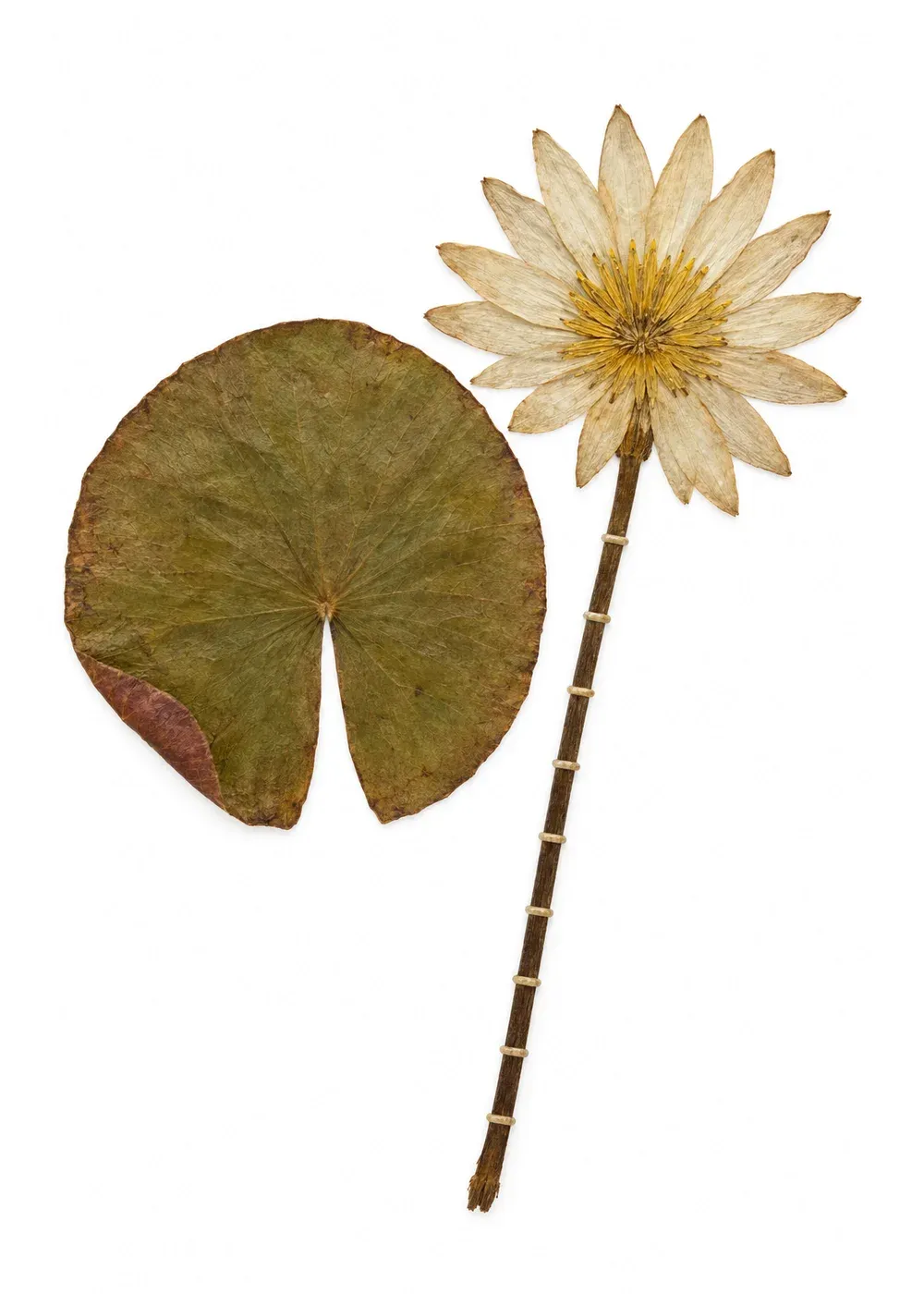
Grace Lily
Nymphaea moratoria
A Lapland water lily that, for the nine weeks it is in flower, stops every legal deadline in sight of its pond: tax, leases and evictions.
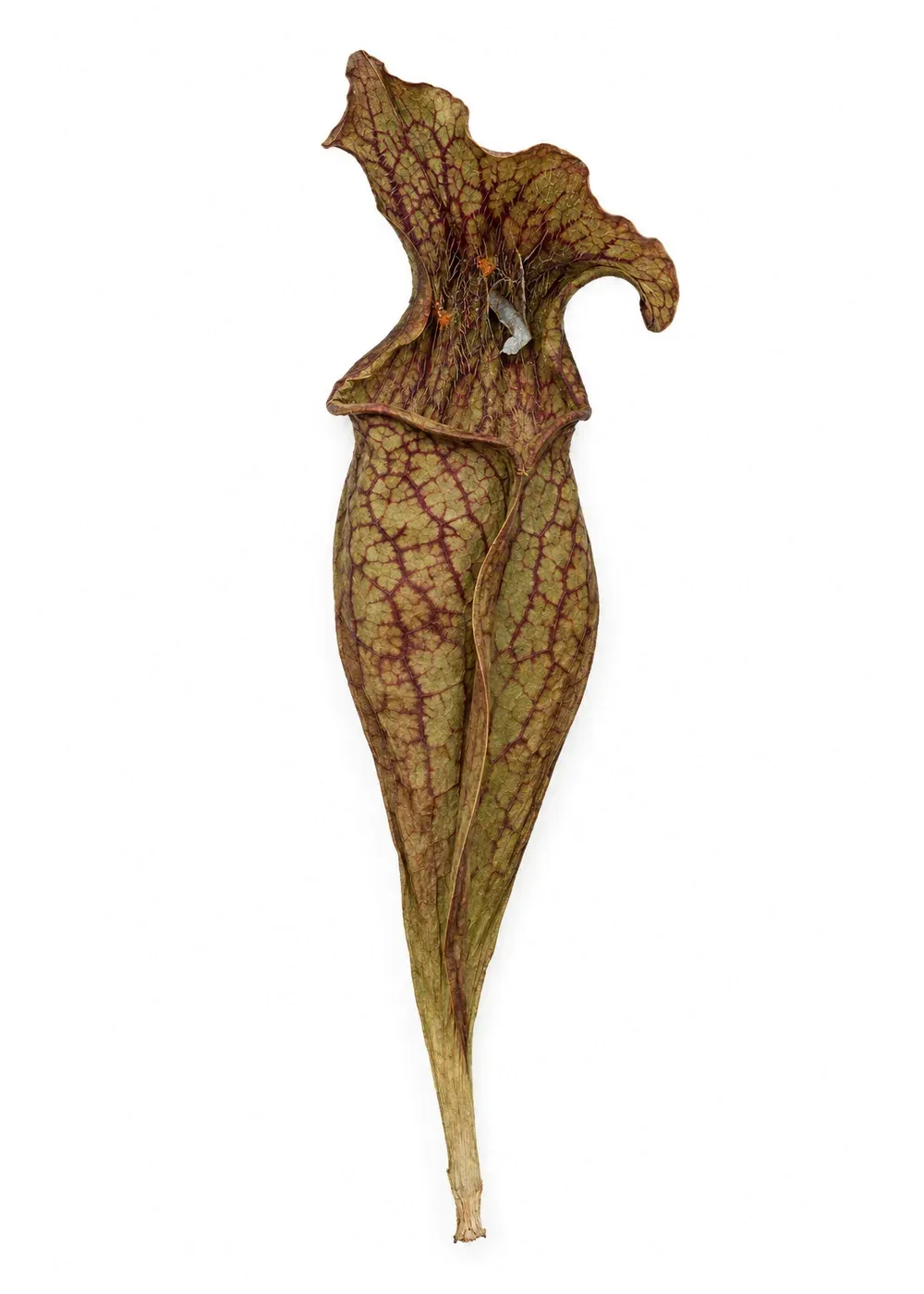
Tithe-Map Pitcher
Sarracenia purpurea
A purple pitcher plant whose tin chapel turned up in a 1790 vestry minute, just in time to beat a council demolition order.