- No.
- H-0524
- Fam.
- Lauraceae
- Loc.
- Rio Tefé, Amazonas, Brazil
- Leg.
- Dr Hélio Barcellos Prado, meteorologist, August 1976
H-0524HerbariumLauraceae
Relay Laurel
Aniba vicaria
ArchivedA Brazilian laurel with no scent in the air, whose smell came out of every radio in Worcestershire the morning its seed packet was opened on air.
- Collected at
- Rio Tefé, Amazonas, Brazil
- Date
- August 1976
- Collector
- Dr Hélio Barcellos Prado, meteorologist
- Anomalies
- Chemical
Sequenced fragment
ATGGCTTCCTCTCAAGTTCTTGCTTCTTCAAAGCCATTGGCTATATGCGCATATGCGCATATGCGCGAGAACCGTCCAAGTGCAAATTATCA
Contents 6 sections
Description
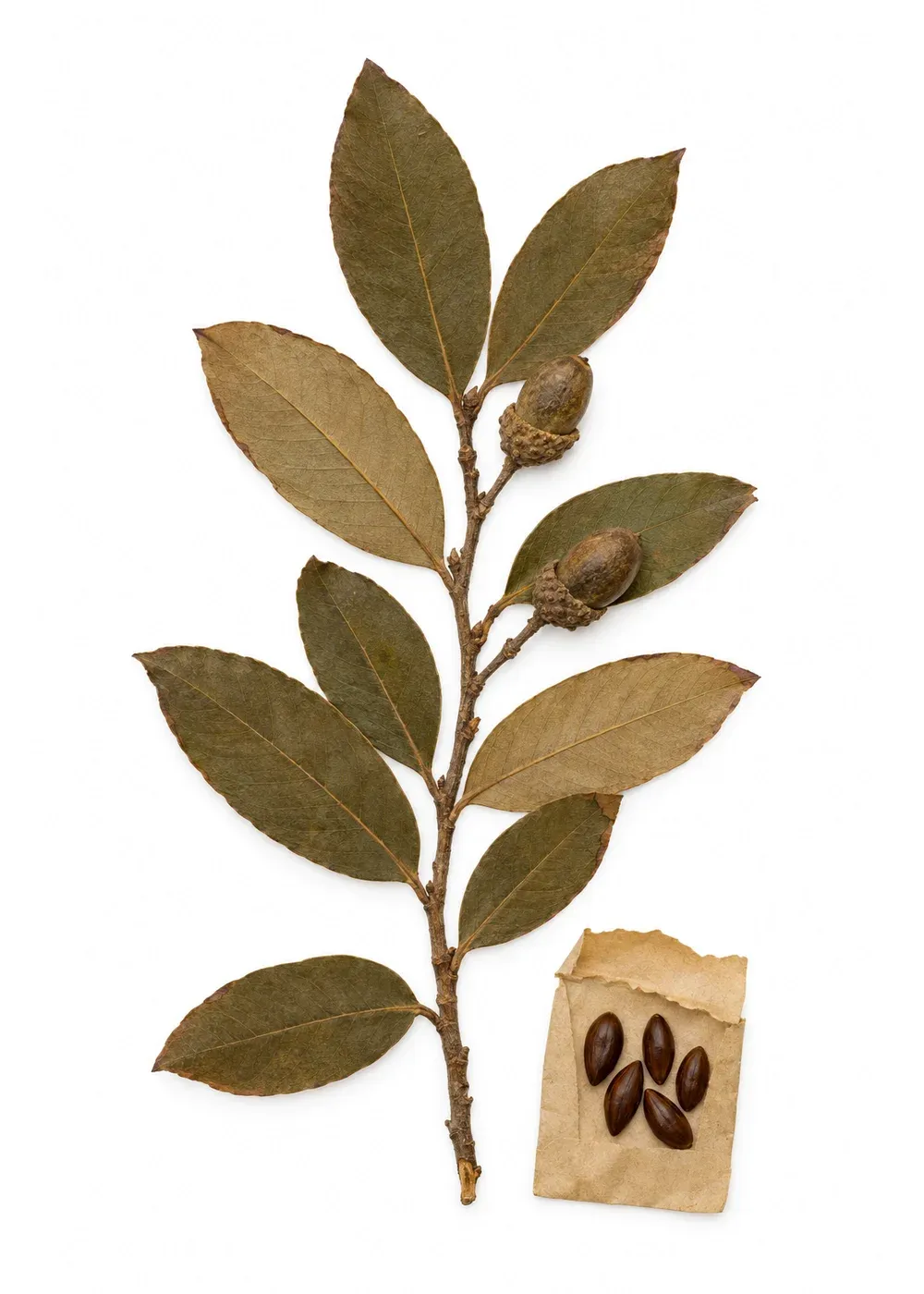
A pressed flowering-and-fruiting twig of a small evergreen tree, 32 cm, with grey-brown lenticellate bark. Leaves are alternate, elliptic to obovate, 9–15 × 4–6 cm, coriaceous, shortly acuminate, glabrous above and finely brown-puberulent beneath, with 6–8 pairs of lateral veins. Two fruits remain: ellipsoid drupes about 2 cm long, each seated in a shallow warty cupule. Held with it, as H-0524b, is the original seed envelope containing five seeds, dark brown, 1.4–1.6 cm.
Observations
H-0524 has no scent in air. Its scent is detectable only after it has passed through a microphone.
In the room
Headspace GC-MS of crushed leaf (1983, 2009) found no linalool and no terpene volatiles above background. A six-person sensory panel reported dust. The seeds, the cut wood and the pressed leaves behave the same.
Through a microphone
Any microphone within about 2 m of crushed leaf, cut wood or an open seed takes the odour into whatever it feeds: a transmitter, a telephone line, a tape. Every receiver on that signal gives it out at the loudspeaker as a smell, consistently described as rosewood, pencil shavings and orange peel. Its strength follows the volume control and it is gone within seconds of muting. It does not show in the audio: meters, waveform and tape hiss are normal.
Dr Prado identified the tree in 1976 because operators in Manaus, 520 km away, smelled rosewood whenever Tefé transmitted from the radio hut beneath it, and never when it transmitted from the airfield.
The voucher
The pressed twig still does it, more weakly, after fifty years. It is kept in the one catalogue room without a telephone.
The file
The file was assembled in 1979–80 by Douglas Fairlie, loss adjuster for the Mercia & Provincial Mutual, which insured the studios of Radio Kempsey, Worcester. Fairlie dictated his documents onto cassette for the typing pool in Foregate Street. His notes are marked DF. The file came to the Conservatory in 1981 with the seed packet, and is kept as received.
The Sunday Garden, Studio B
Transcript typed from Radio Kempsey’s logging tape — dictated by D. Fairlie, cassette 1, typed by M. Pugh
Opening
CLIVE TOLLEY: Eleven minutes past ten, and this is The Sunday Garden, live from Studio B. It’s raining here on Sansome Walk and, I’m told, not in Evesham. Later, from the Conservatory, Miss Ruth Allardyce, who has brought something in an envelope.
[DF: Times from the tape counter, checked against the engineer’s sheet.]
A listener writes
TOLLEY: Mrs Joan Wheeler, Upton-upon-Severn: “My bay has gone brown at the tips after the frost. Do I cut it back?” Not yet, Mrs Wheeler. Wait for April. Bays are stubborn.
Studio guest
RUTH ALLARDYCE: This is a seed packet from a meteorologist in Brazil, a Dr Prado, who runs a weather station at Tefé on the Amazon. A laurel. A cousin of Mrs Wheeler’s bay, as it happens. He sent it to us in 1977.
TOLLEY: Unopened?
ALLARDYCE: We don’t open seed until we mean to sow it, and this is on the list for spring. There’s something on the back in pencil, in Portuguese.
TOLLEY: Which says?
ALLARDYCE: I don’t read Portuguese. [paper tearing, close to microphone] Six seeds. About the size of an olive stone. Smell.
TOLLEY: Nothing. Dust.
ALLARDYCE: That’s what his letter says. No scent at all, which is odd for the family. He says the radio operators could smell it, but not —
[DF: Engineer’s sheet, 10.24: all six switchboard lines lit. Normal Sunday maximum is two.]
Telephone line
TOLLEY: We seem to be popular. Mr Dennis Hartop, Droitwich?
HARTOP: What have you got in there? My kitchen smells like a timber yard. Oranges in a timber yard. It’s coming out of the set.
TOLLEY: Out of the —
HARTOP: I’ve put my nose to it. It’s the grille.
TOLLEY: Mrs Pauline Ince, Malvern Link?
INCE: Pencil shavings. My husband turned you down and it went fainter, and he turned you up and —
TOLLEY: Pete in the control room says he can smell it on his monitors. I’m a foot from the thing and I can’t smell anything at all.
[DF: The studio speakers are cut while the microphone is live. Mr P. Gully, engineer, smelled it only through the control-room speakers.]
Closing announcement
CONTINUITY (MARGARET OKE): Radio Kempsey apologises for a technical fault affecting The Sunday Garden. We continue with music from Studio A. It’s ten forty-one.
[DF: The packet was folded shut and put in the left-hand drawer of the Studio B desk, where it stayed nine days. Every live programme from Studio B in those nine days carried the smell, weaker, live advertisements included.]
Plates — Radio Kempsey, Studio B claim
Photographs taken by D. Fairlie, loss adjuster, with his notes from the backs — cassette 2, typed by M. Pugh
Plate I — Studio B, from the control-room glass
Desk, left drawer, 40 cm below microphone 1. Packet in the drawer 11–20 March. Studio B out of use 23 days. Business interruption claimed: £4,118, advertisers’ refunds included. The Pershore bakery says its own advertisement smelled of pencils and considers this a loss. I do not have a figure for it.
Plate II — The packet, front
Buff paper, 9 × 6 cm, Conservatory accession stamp. Torn across the top on air. Five seeds inside on my count, 22 March, in the car park. Miss Allardyce says six on air. Studio B searched twice, desk and carpet. Nothing.
Plate III — The packet, reverse
Pencil: Não abrir perto de microfone. Translated by Mr A. Fernandes, who teaches Portuguese evening classes at the technical college: “Do not open near a microphone.” On the packet two years before anyone turned it over. Not an exclusion under the policy.
Plate IV — Monday’s post, reception desk
Two sacks on the Monday, 611 letters and cards by the Friday. Station’s tally: 214 pencils, 97 oranges, 41 “church”, 30 “my father’s workshop”. Six ask for it to be played again. One is from Ward 4, Ronkswood Hospital: “The ladies would like it on Sundays.”
Plate V — Mrs Ivy Garrod’s wireless, Pershore
Claim 7/114. Set replaced, £23.40. She says it smelled all that week whenever she had us on. True of every set in range while the packet was in the drawer. Old set taken in. In our office it smells of nothing, tuned to anything.
Plate VI — Blank
Studio B, 22 March, drawer open, packet on the desk, microphone live. Nothing to see. Included for completeness.
Instructions for the keeper of item 7
Written by R. Allardyce for the Blackpole salvage store, read onto cassette 3 by D. Fairlie at the store — typist not recorded
Step 1 — Receiving the tin
The packet comes in a biscuit tin with the lid taped. Leave the tape on. Sign Mr Fairlie’s sheet. Do not carry it past the switchboard.
Step 2 — The room
It needs a room with no telephone, intercom, radio, television, tape recorder or dictating machine. The basement will do once the extension is taken out. Microphones are what matter. Speakers do not.
Step 3 — Temperature
Between 12 and 18 °C. Do not refrigerate it and do not let it dry. Laurel seed dies below about ten degrees, or when dried, and these may already be dead. That will not change the smell.
Step 4 — Visitors
Ask anyone who comes in whether they wear a hearing aid. Mr Nash, the foreman, does. He smelled it once in the corridor, when his aid whistled.
Step 5 — Checking
Look at the tape once a month. Do not open the tin to count. There are five. We have not found the sixth and have stopped looking in Studio B.
Step 6 — If the tin is opened
Close it. Leave the room and shut the door. Ring the Conservatory from the upstairs office, not the corridor. When we answer, do not describe it. Hold the receiver a little away from your face and
Genetic analysis
The plastome places H-0524 within Aniba, nearest A. rosaeodora, the rosewood, whose oil is about 85% linalool. Its linalool synthase, AvTPS1, is intact and strongly transcribed in leaf and seed, and the enzyme can be extracted.
The fragment is the start of that gene. The transit peptide, which should carry the enzyme into the plastid where linalool is made, holds a 24-base insert of strict purine–pyrimidine alternation. It switches from AT to GC every four bases, three cycles, with no mismatch in any of eleven readings. No homologue exists in any database. Immunolabelling finds the enzyme in the cytoplasm and nowhere else, and no product has ever been found.
In 1998 the trace files were sent by modem to a collaborating laboratory in Edinburgh. Their reply asked what we had spilled on the line.
Cultivation
Not cultivated.
- Aniba seed is recalcitrant and dies if dried or chilled. The five seeds in H-0524b spent nine days in a studio desk and fourteen months in an insurer’s basement, and are probably dead.
- They have never been tested for viability, because the tetrazolium test means cutting one open.
- In a letter of 1981 Dr Prado reported the parent tree still standing beside the radio hut at Tefé, its lower branches cut back from the aerial lead. He did not offer more seed, and the Conservatory did not ask.
The Conservatory has turned down three requests to borrow the seeds: two from broadcasters and one from a perfumer.
Effects
In the same room as the plant, people notice nothing.
Through a receiver, the smell has done no recorded harm. Nobody was taken ill in March 1979. Fairlie settled 38 domestic claims, nearly all for radios people no longer trusted, and the station’s business interruption claim. Of the 611 letters, six asked for it again and one came from a hospital ward.
The smell travels as far as the signal goes. In 1979 that was Radio Kempsey’s medium-wave coverage, from Gloucester to Kidderminster, and one lorry cab on the M5 near Strensham. On a telephone line it is one handset. The logging tape gives it out every time it is played, and is kept with the specimen as H-0524c.
Radio Kempsey turned Studio B into a record library in 1980. Staff called it the cedar room until the station closed in 1994.
Filed alongside
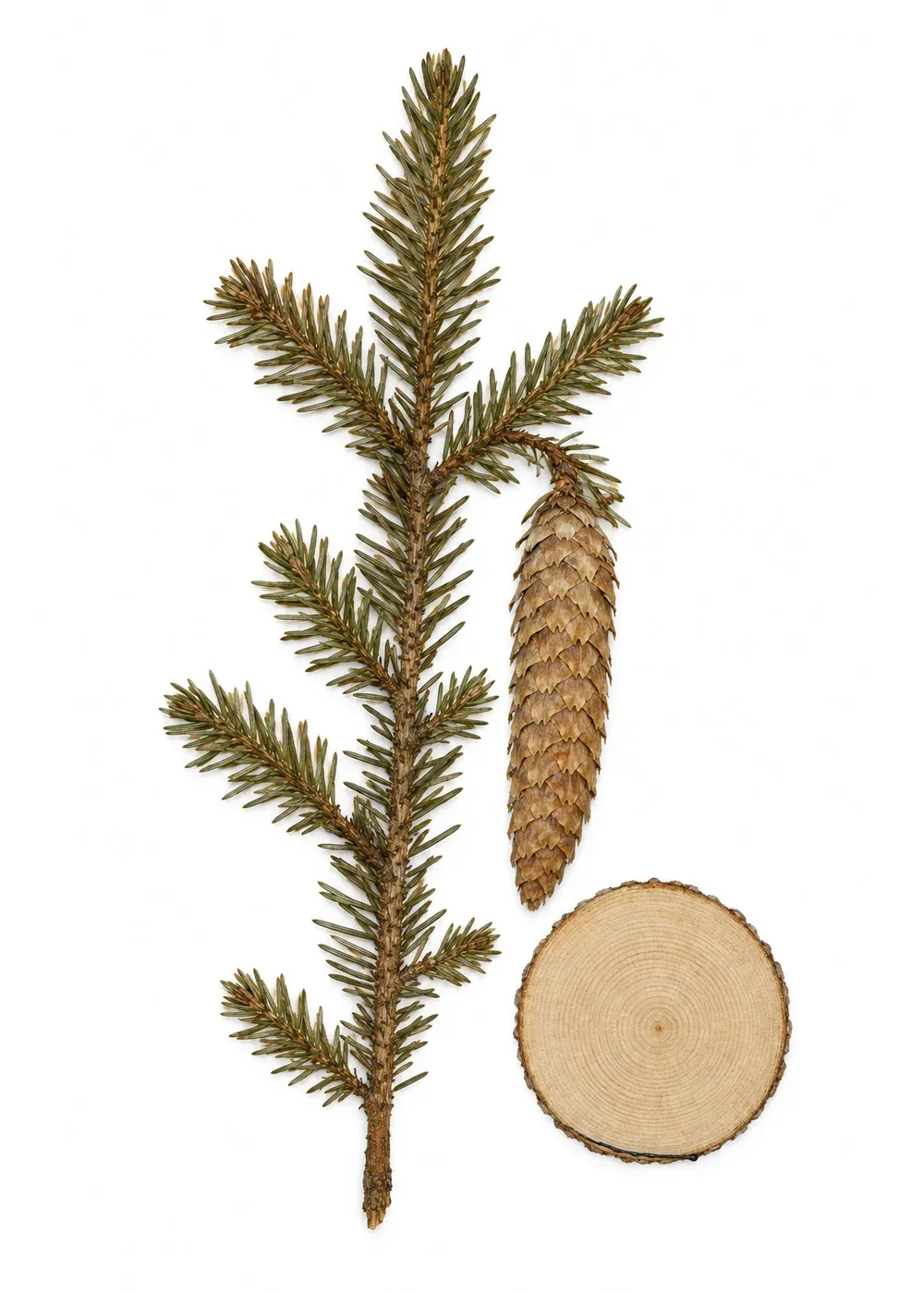
Bad-Faith Spruce
Picea abies
Paper pulped from a Carpathian spruce sheds the ink of any promise its writer means to break, and one herbalist's card has lost a child's dose.
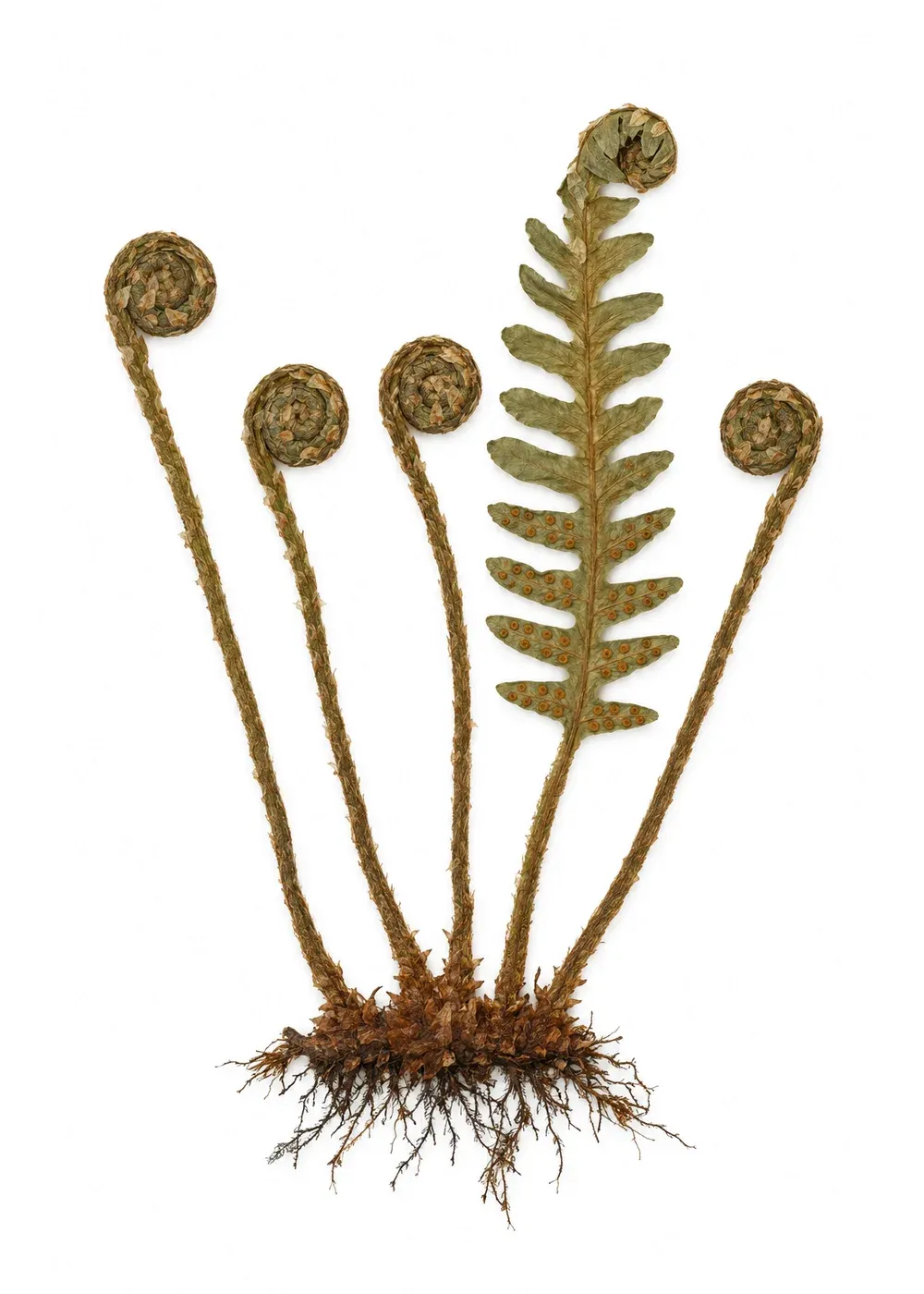
Widow's Fern
Polypodium memorans
An ordinary fern whose fronds uncurl only near the recently bereaved — and whose genome remembers who was lost.
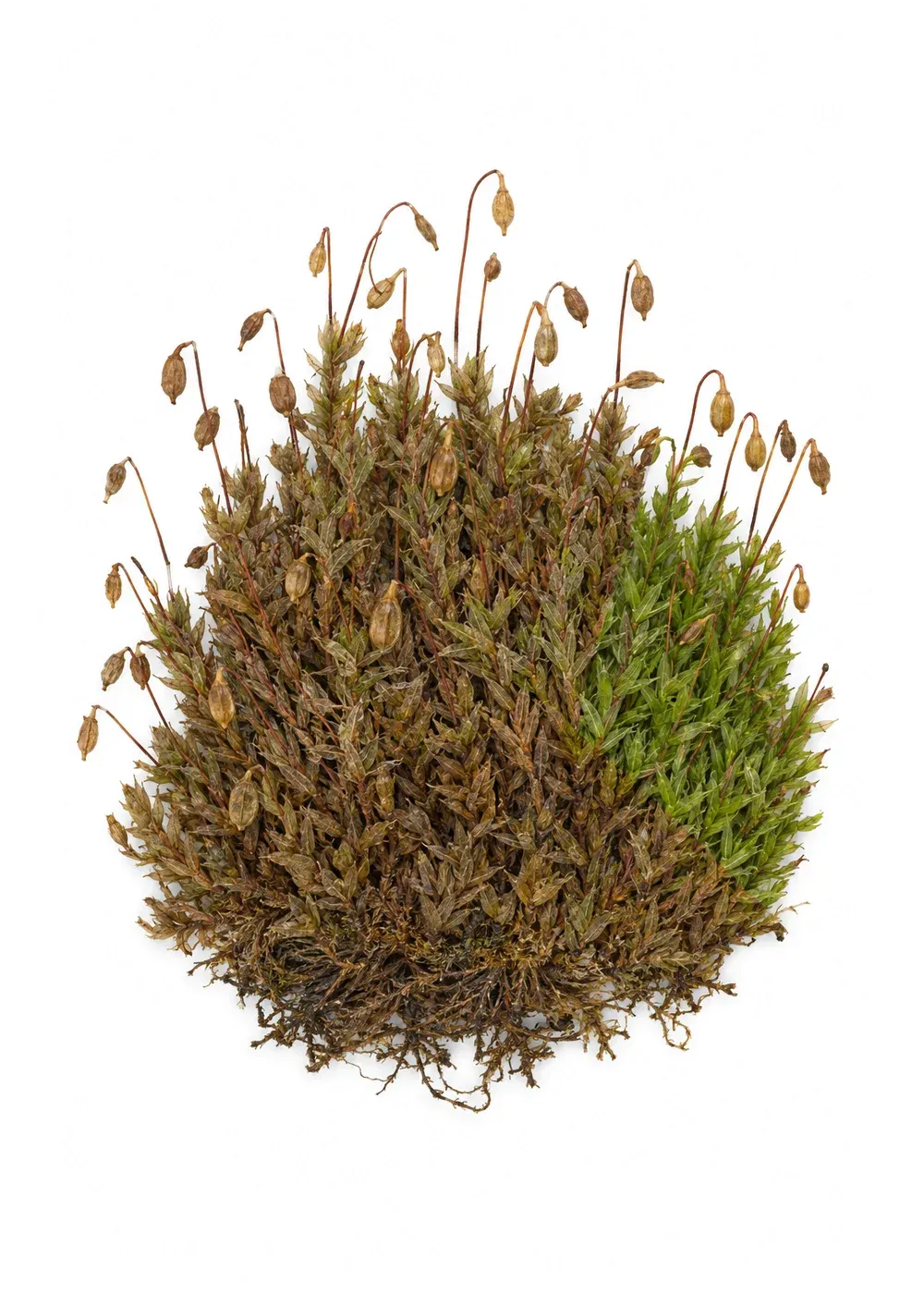
Lamplighter's Moss
Bryum vesperale
A cushion moss that photosynthesises from attention rather than light, and dies in rooms nobody visits.