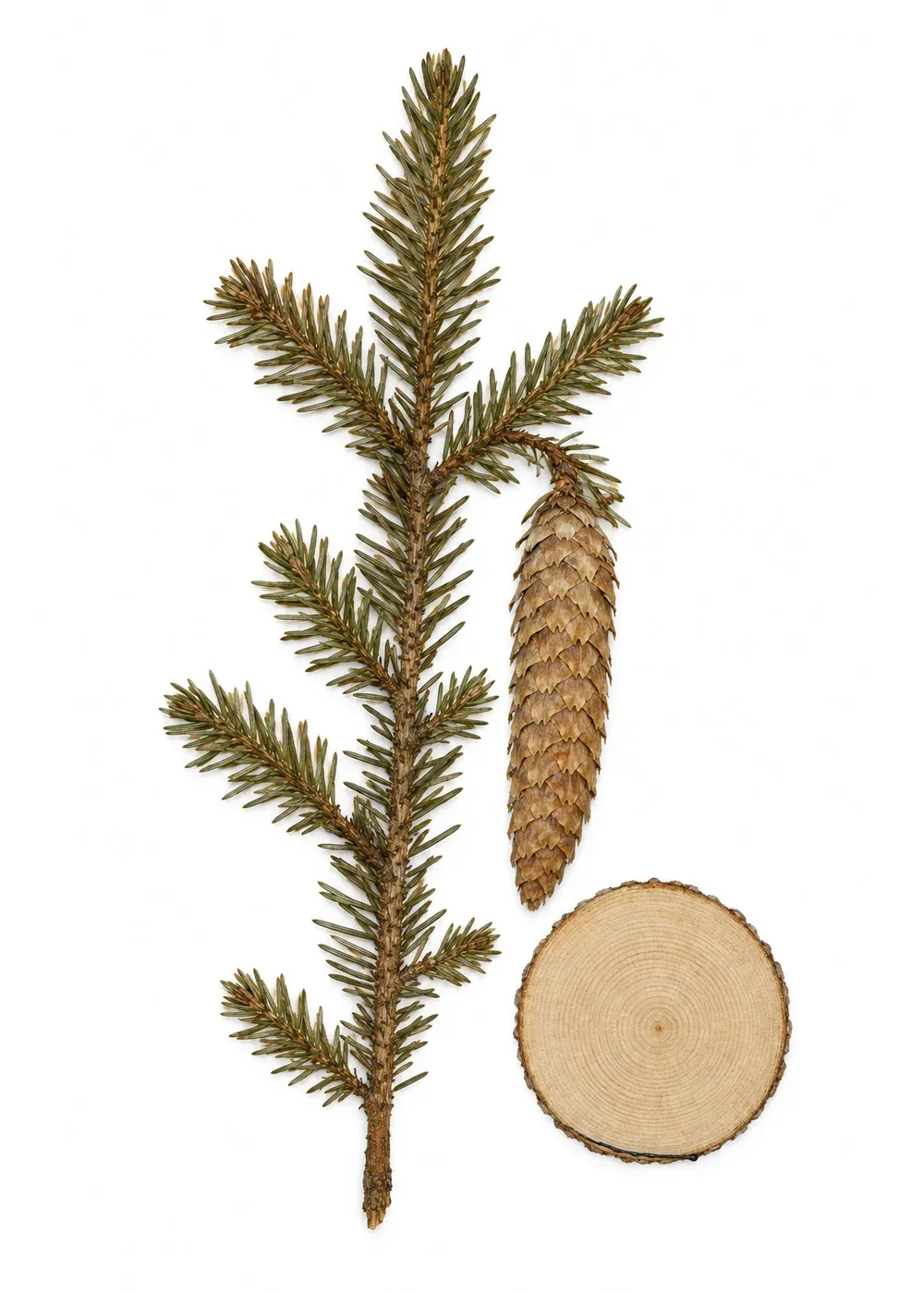
- No.
- H-0541
- Fam.
- Pinaceae
- Loc.
- Jasiňa, Subcarpathian Ruthenia
- Leg.
- Josef Kubát, army radio operator, February 1934
H-0541HerbariumPinaceae
Bad-Faith Spruce
Picea abies
ArchivedPaper pulped from a Carpathian spruce sheds the ink of any promise its writer means to break, and one herbalist's card has lost a child's dose.
- Collected at
- Jasiňa, Subcarpathian Ruthenia
- Date
- February 1934
- Collector
- Josef Kubát, army radio operator
- Anomalies
- EconomicChemical
Sequenced fragment
ATGGAGGCTAATGCTGGTCTTGTTGCTGGATCATACAGAAGATGCAGGTCATCGATGACCTGCATTTCAGAGGTTGGCTCAAGAACAATGG
Contents 6 sections
Description
A pressed terminal shoot of Norway spruce, 34 cm long, with side branchlets up to 12 cm. The needles are four-angled, 14–19 mm long, stiff and sharp-tipped. They have dried from dark green to olive-brown, and most are still attached. One mature female cone, 13 cm long and pale chestnut, hangs from the shoot. Its scales are rhomboid with notched tips. Held with the shoot are a disc cut from the trunk-top, 11 cm across with 31 annual rings, and 212 unused cards of coarse cream-grey pulp paper, each 10 by 15 cm.
Observations
Ink will not stay on paper pulped from this tree when the writer does not intend to keep what they are writing. The effect applies only to undertakings: promises, debts, doses, terms and dates of return. Descriptions, recipes and lists stay on the paper as normal.
Failing ink beads within a minute. Over anything from forty seconds to three hours it slides to the lower edge, where it dries as a straight thread of pigment that can be brushed off. Pencil, typewriter ribbon and printer’s ink all behave the same way. In 1949 staff wrote forty undertakings they meant to keep and forty they did not, and all eighty sorted correctly. The paper reads intention at the moment of writing. A promise made sincerely and broken later stays on the card.
The file
In February 1934 the army felled a spruce near Jasiňa to clear the line of its aerial. The radio operator, Josef Kubát, pressed a shoot from it and took the trunk-top to his landlady in Rakhiv, the herbalist Paraska Kostiuk. She had the trunk-top pulped at the mill in Kobyletska Polyana and printed remedy cards and IOU slips on the paper. Complaints about the slips reached us from 1936, and we sent them to her to answer. In 1948 she posted us the branch, the cards and her copy of the register. The order of the papers and the margin notes are hers.
For complaints of the chest and of the house
Remedy cards on paper from the Jasiňa spruce, with a ration book filed among them — P. Kostiuk, herbalist, Rakhiv
Every card here is on the Jasiňa paper. Read them. You will find nothing missing that I put there. — note tied round the bundle, in her hand
For a cough that settles on the chest
A handful of dried needles from the Jasiňa top, steeped overnight in a quart of water, then boiled for a quarter of an hour with honey.
Dose: one cup in the evening, for three evenings. If no better, come back and I will look at the throat.
Paid: 2 Kč, or eggs.
For a wound that will not close
Resin from the trunk-top, melted with an equal weight of lard and strained through linen.
Dose: spread thin, morning and night, under a clean cloth. I will change it myself on the Thursday.
Margin: Hanna Moroz. Closed in eleven days.
For a cough in a small child
Syrup of the tips, boiled hard with sugar. The sugar is from the household book, filed with this card.
For Olenka Bilak, aged three, of the lower street.
Dose: [line bare; faint nib grooves in the paper; a dry thread of black pigment along the lower edge]
Paid: see slip. [No slip present.]
Margin, in pencil: Damp in the drawer, March. The dose was the usual.
[Found folded inside a household ration book issued by the Rahó district office for 1943. A paper label has been pasted over the name on the cover: “To show the date of the cards — P.K.” The sugar coupons for weeks 1 to 9 are cut out. From week 10 onward the coupons are whole.]
For a debt between neighbours
Both of you write it on this card, each in your own hand. What stays is owed. What goes was never going to be paid, and you may stop waiting for it.
Dose: once. Keep the card in the house, not in the drawer.
Complaints register — paper from H-0541
Her copy of our complaints register; she drafted the replies and we sent them under our cover. Annotated by P. Kostiuk
Ref. 2229 — A blank lease
Ferenc Szabó, innkeeper, Kőrösmező, encloses a grazing lease written on one of the Rakhiv slips. The tenant’s terms are still there. His own terms as lessor have gone, along with his signature. He asks what the Conservatory intends to do about it.
Reply: The tenant’s half has stayed. We would read that half before blaming the paper.
Margin: He never paid the Hrytsiuks for the hay either.
Ref. 2231 — A wedding settlement
Vasyl Dutka, Bilyn, encloses his son’s marriage settlement. The bride’s family’s clauses are whole. Of the groom’s side, only the cow remains.
Reply: We cannot restore the clauses. The family may wish to be grateful for the cow.
Margin: The girl married in the end. Somebody else.
Ref. 2234 — Slips by the hundred
Mendel Klein, grocer, Rakhiv, returns a block of 140 IOU slips his customers wrote out over the winter. Sixty-one of them are blank. He asks for his money back for the block.
Reply: The paper did not lose you sixty-one debts. It told you about them early.
Margin: I sold him the block at cost. I refunded nothing.
Ref. 2236 — The herbalist’s own cards
Dr Kálmán Végh, district physician, Rahó, writes that the herbalist Kostiuk is practising without a licence. He asks whether the Conservatory vouches for her cards.
Reply: Every card in my drawer is complete. He may come and read them on any weekday.
Margin: Every card. I have been through them twice.
Genetic analysis
The specimen is Picea abies. Its chloroplast haplotype is common in the eastern Carpathians, and its overall GC content of 37.9% is typical of the species. The anomaly is in exon 2 of CesA8, one of the cellulose synthase genes that build the secondary walls of wood fibre, which is the part of a spruce that becomes paper. Twenty-four bases have been inserted in frame, adding eight amino acids. The insertion is a perfect reverse-complement palindrome: it reads the same on either strand, in either direction. It is present in the shoot, the cone scales and the trunk disc. It is absent from 31 spruces sampled along the Chorna Tysa in 1958. The cellulose the gene produces is ordinary under every test we have run.
Cultivation
Not cultivated. Sixty seeds were taken from the cone in 1949. Three germinated, and none survived its second winter. In 1962 two grafts onto common spruce stock took and grew normally. Paper made from their prunings in 1963 held every ink, honest or not, and the grafts were removed. The Board declined further attempts in 1964 and minuted its reason in one line: “We have enough paper.” The 212 remaining cards are kept in a locked drawer and are not issued.
Effects
The effect travels with the paper, not the tree. About 3,000 sheets were made in 1936, and a little over 200 are known to survive. People who watch their ink slide do not usually argue with it. In Rakhiv in the late 1930s, people asked for a “Kostiuk slip” at betrothals and cattle sales, and a refusal to write on one was answer enough. Shopkeepers who used the slips gave less credit and lost less of it. The thread of pigment left at the lower edge cannot be used again: ink scraped from a failed card and rewritten on ordinary paper behaves normally. Staff are asked not to write on the cards. Most have, once.
Filed alongside
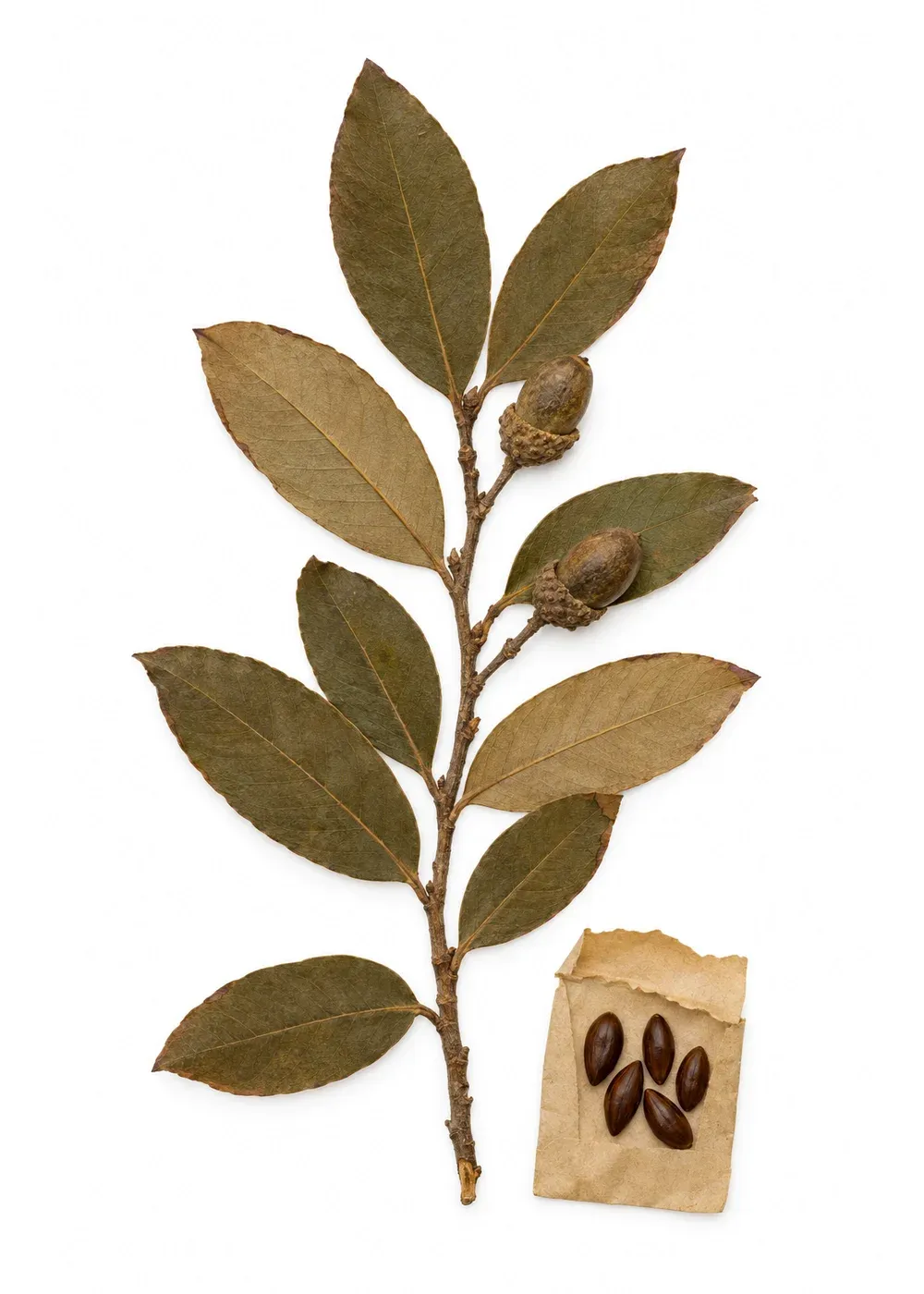
Relay Laurel
Aniba vicaria
A Brazilian laurel with no scent in the air, whose smell came out of every radio in Worcestershire the morning its seed packet was opened on air.
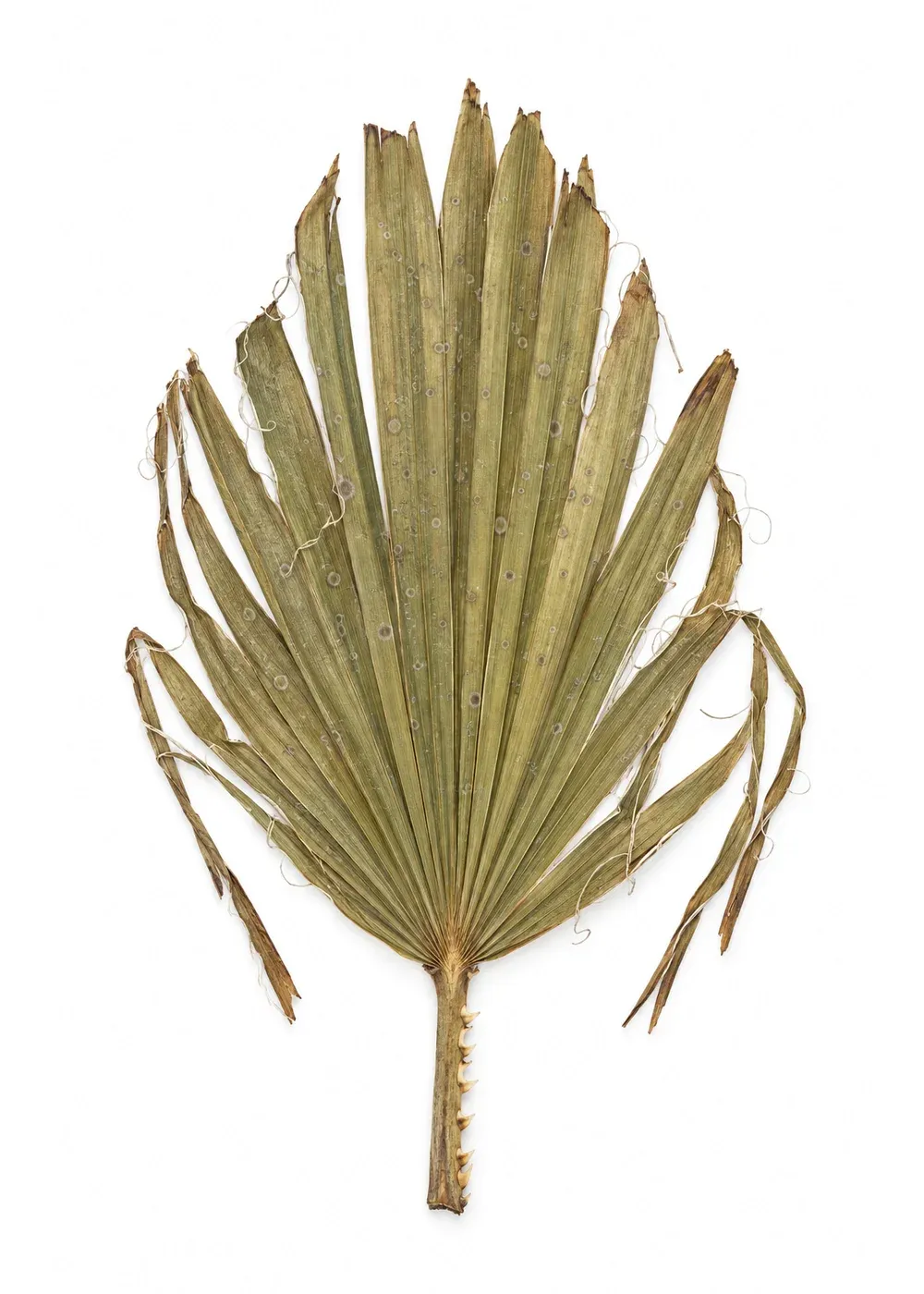
Square-Account Palm
Washingtonia filifera
A fan palm from a Basque net-loft yard keeps the sky over the Palm House grey for as long as anyone beneath it owes money to anyone else.
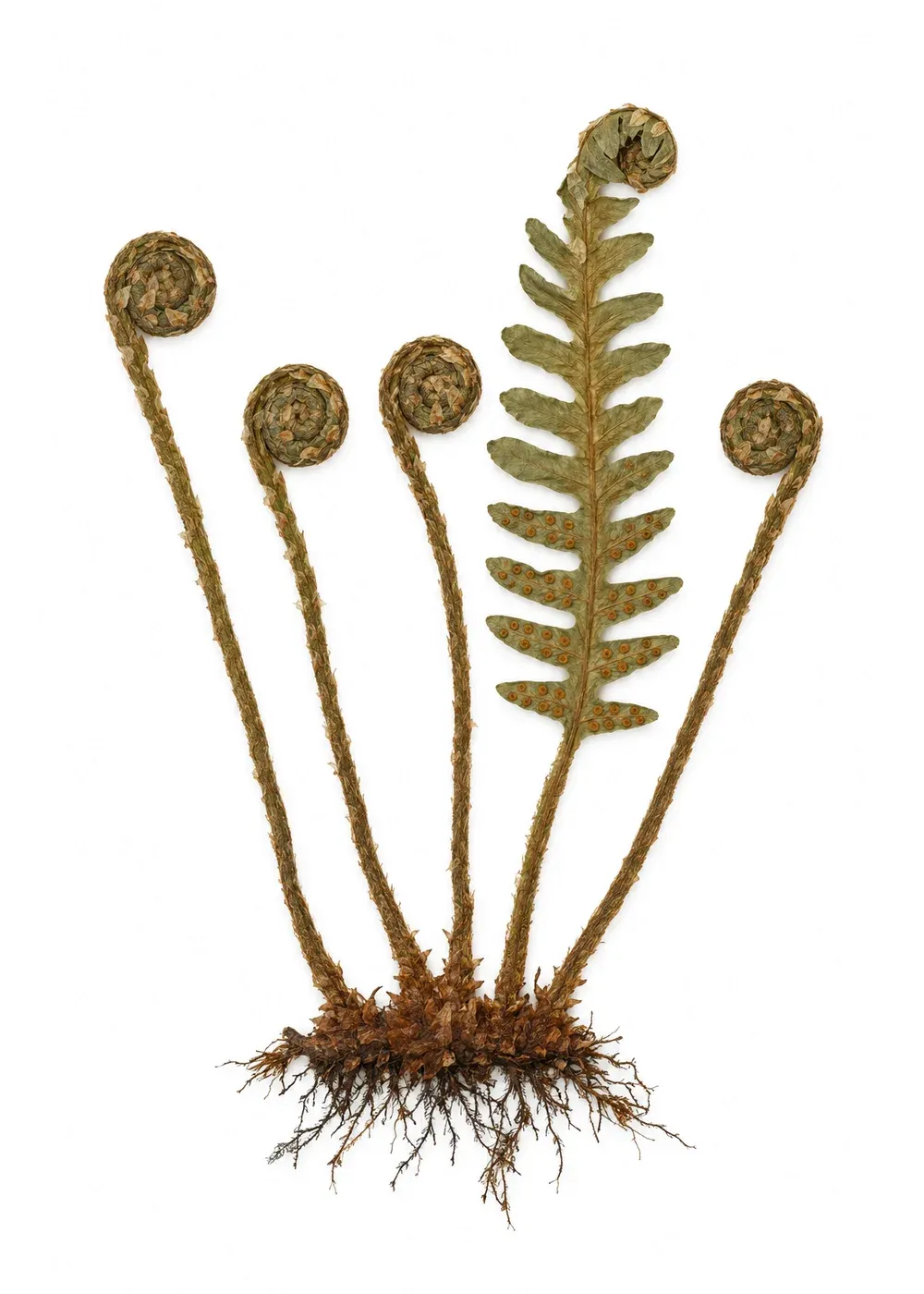
Widow's Fern
Polypodium memorans
An ordinary fern whose fronds uncurl only near the recently bereaved — and whose genome remembers who was lost.