- No.
- H-0526
- Fam.
- Cyperaceae
- Loc.
- Île de Fédrun, Grande Brière
- Leg.
- Hervé Mahé, hotel concierge, 1996
H-0526HerbariumCyperaceae
Honest-Signal Saw-Sedge
Cladium mariscus
ArchivedA stand of saw-sedge in the Brière left lapwings unable to fake a broken wing and a guest's setter unable to play, until a hotel paved it over.
- Collected at
- Île de Fédrun, Grande Brière
- Date
- 1996
- Collector
- Hervé Mahé, hotel concierge
- Anomalies
- Mimicry
Sequenced fragment
ATGGCTTCAACCGTGAAGCTTGCATCCGATGCAAGGACTAGTCCTTGCATCGGAGGTACCTTAGAGCAATCGTTGAAC
Contents 6 sections
Description
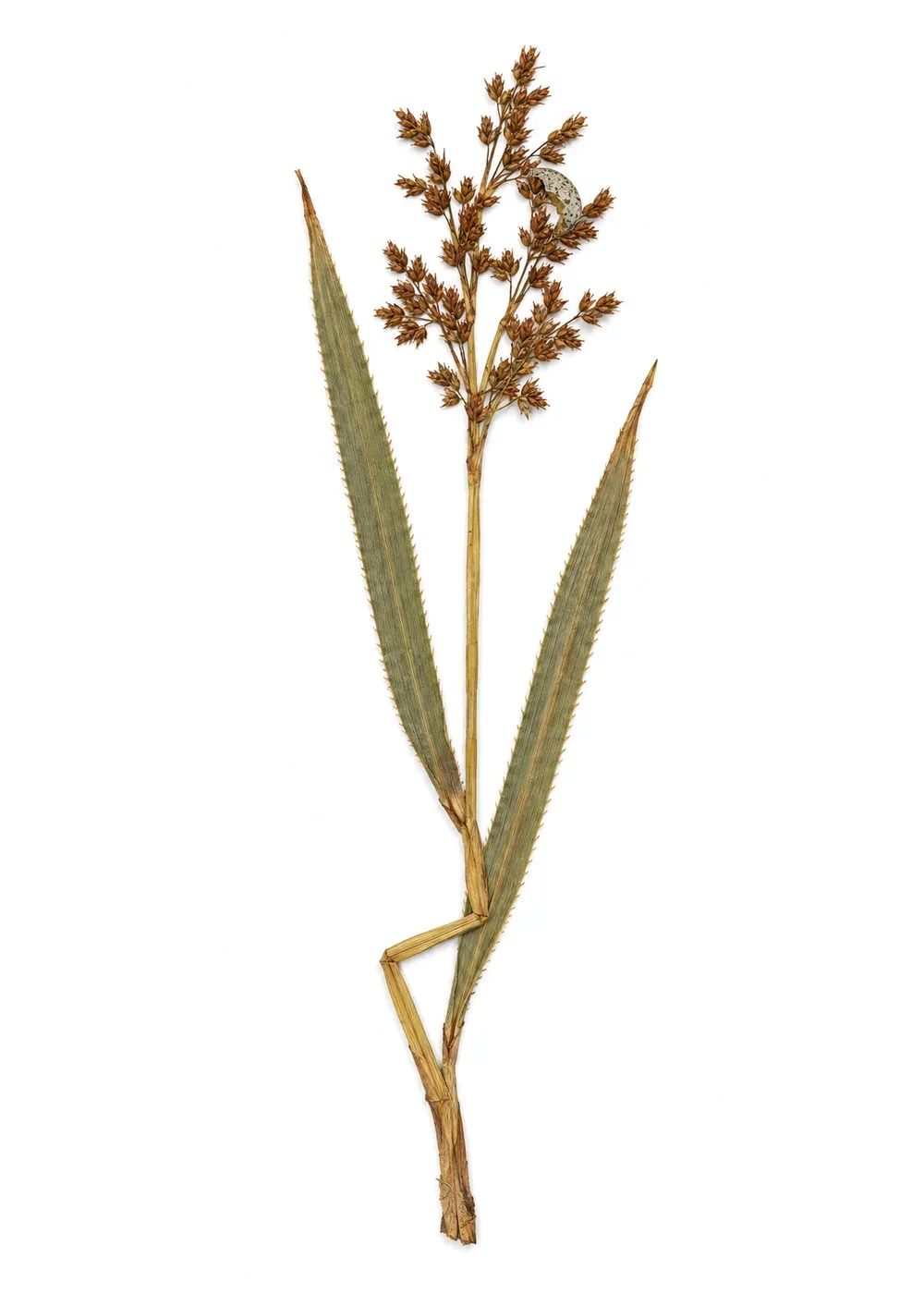
A single flowering culm of great fen-sedge, cut at 88 cm and folded twice. The culm is stout and leafy to the top. Two leaves remain attached. Each is 1–1.5 cm wide, rigid and keeled, with fine forward-pointing teeth along both margins and the midrib. The inflorescence is a branched terminal panicle about 30 cm long, made up of dense clusters of small spikelets. Dried, the culm is straw-yellow, the leaves grey-green turning to buff, and the spikelets rust-brown. The nutlets are glossy and dark. When opened, they are empty.
Observations
Between June 1996 and February 1997, animals that fed or nested in one stand of saw-sedge stopped producing deceptive signals. Their honest signals carried on as normal.
The stand
A clonal stand of Cladium mariscus of about 60 m², at the boat landing on the north shore of Île de Fédrun, Saint-Joachim (Loire-Atlantique). It was cut and surfaced in February 1997. Recorded observers: Gildas Aoustin, boatman, and Hervé Mahé, head concierge of the Hôtel des Ajoncs, La Baule.
Displays recorded absent
- Northern lapwing: no broken-wing distraction display from birds nesting within 20 m. Foxes took eleven nests.
- Common cuckoo: three eggs laid on bare peat inside the stand. None found in reed warbler nests nearby.
- Grass snake: no death-feigning when turned over.
- Domestic dog: no play-bow from one English setter after she had run in the stand.
What was not affected
Alarm calls, territorial song and a dog’s growl all continued. People were unaffected. The pressed culm has no effect.
The file
The French originals reached me from Nantes in one folder, stapled in the order below, with the ticket in an envelope at the back. I have translated them and kept that order, which is Mme Rouxel’s and not mine. Where I disagree with her transcription, I say so in square brackets. I disagree most with the word the catalogue uses for this plant. — A.-L. Briand
Hervé Mahé, at the Hôtel des Ajoncs
Interview with Hervé Mahé, head concierge, recorded by O. Rouxel, Nantes correspondent; translated by A.-L. Briand
Part one — The landing
Rouxel: You send guests to Fédrun.
Mahé: Every morning in season. Gildas Aoustin takes them out by chaland from the landing on the north side, by the sedge. I tell them his boat is the oldest on the marsh. It is the third oldest.
Rouxel: And the sedge?
Mahé: A patch the size of our dining room. The birds like it. Guests don’t. It cuts your hands.
Part two — The dog
Mahé: Madame Lacroix, room 14, had a setter called Pistache. She let it run in the sedge while she waited for the boat. The next morning on the lawn it would not play with the porter’s boy. A dog goes down on its elbows to say that what comes next is not serious. After the sedge, Pistache could not pretend, so she did not bow.
[Tr.: Mme Rouxel types this as she bowed only when she was sincere. That is not what he says. He says elle ne savait plus faire semblant: she no longer knew how to pretend. Play is pretending.]
Part three — The birds
Mahé: Gildas showed me. A lapwing gets up off her eggs and walks away. No dragging the wing, nothing, and the fox walks in. There were three cuckoo eggs on the bare peat, in nobody’s nest. A boy turned a grass snake over with an oar and it just swam off.
Rouxel: So they are honest.
Mahé: That is your word, madame.
[Tr.: It is the Conservatory’s word too. It is not his.]
Part four — The ticket
Rouxel: You keep a count.
Mahé: On the back of a Loto ticket. Every time Gildas or I see an animal not do the false thing, I make a mark. Seventy-four so far.
Rouxel: Did the ticket win?
Mahé: Forty francs. I have until the end of the month. If I take it to the tabac they keep it, and then I have no count.
Rouxel: And the hotel’s landing stage?
Mahé: It will come to nothing. Gildas has already written to the mairie.
After the tape stopped
Mme Rouxel’s note, typed under the transcript: M. Mahé walked me to the door and told me my room had been the best in the house.
[Tr.: It was room 31, over the kitchens. Her bill is in the folder.]
Key to the Fédrun sedge
Identification key worked from the culm Mahé posted to the Conservatory — E. Probert, herbarium botanist
1a — Stem solid, leaves three-ranked
Sedge family. Go to 2. The culm arrived folded inside a hotel telephone directory, at the Saint-Joachim pages.
2a — Leaf margins and keel saw-toothed
Cladium. Go to 3. Handle with gloves. Mr Mahé did not, and his letter says so.
3a — Panicle of brown spikelet clusters
Cladium mariscus, great fen-sedge. Normally the key ends here. Go to 4. A fragment of speckled eggshell is caught among the spikelets. I have left it there.
4a — Animals in the stand display falsely
Ordinary C. mariscus. Stop.
4b — Animals in the stand cannot pretend
H-0526. This character can only be tested in the stand. The stand is now under a landing stage and thirty parking spaces; it was cut in February. Keyed from the culm alone. The ticket wrapped round the culm is for the Loto draw of Saturday 1 June 1996 and has been worthless since 31 July. It carries 119 marks. He writes that he made the last one on the morning the cutters came.
Staff words at the Ajoncs
Words used by the staff of the Hôtel des Ajoncs, written out by H. Mahé for O. Rouxel; translated by A.-L. Briand
To lapwing (v.)
Faire le vanneau. To lead a guest away from something by putting on a show of difficulty: a lift that is out of order, a table that has just been taken. “The birds have stopped lapwinging. We have not.”
Unbowed (adj.)
Sans-révérence. Said of a dog that has been in the sedge. The porter’s boy first said it of Pistache, room 14.
Cuckoo (n.)
A guest who books under someone else’s name. Room 22, most weekends. [Tr.: Mahé adds that the real cuckoos have stopped doing it. I would say they have stopped being cuckoos.]
The count (n.)
La coche. M. Mahé’s tally, headed fausses parades absentes (false displays absent). It stood at thirty-one when this list was written up at the bar till.
Landing stage and car park, Fédrun
Objections lodged with the mairie of Saint-Joachim against the Hôtel des Ajoncs application, with the officer’s responses; translated by A.-L. Briand
Objection 1 — Gildas Aoustin, boatman
I have taken boats from this landing for twenty-six years. The sedge you mean to cut is the only place on the marsh where a lapwing will not put on a show for a fox. This summer I lost eleven nests to it. Leave it anyway.
Officer: Loss of trade and nesting success are not material considerations. Noted.
Objection 2 — Saint-Nazaire bird club
Three cuckoo eggs on open peat and no lapwing distraction displays in one stand of Cladium. This is of scientific interest.
Officer: C. mariscus is not scarce in the Brière. The stand has no designation.
Objection 3 — Hervé Mahé
I am employed by the applicant. I object. I have one hundred and two occasions on record.
Officer: The objector was invited to submit his record. He would not part with it.
Officer’s summary
Three objections, none material. Recommended for approval on two conditions: cutting to take place outside the nesting season, between 1 November and 28 February, and cut material to be removed from site and not burned.
Genetic analysis
In 1998, DNA was extracted from a leaf base of the pressed culm. The fragment comes from the nuclear ITS2 region, the standard barcoding locus for sedges. Its flanks match C. mariscus from the Brière and the Somerset Levels. The lowercase stretch is a 30-base insertion found in no other Cladium accession. Two neighbouring Brière stands sampled in 1997 do not have it.
The insertion is a perfect inverted repeat: read 5′ to 3′, the strand and its complement give the same thirty letters. Sequences like this usually fold back into a hairpin and show up as stutter on a Sanger trace. This one reads clean from either primer, in eleven runs out of eleven. Read from either side, it says the same thing.
Cultivation
Not cultivated. The stand was cut and surfaced in February 1997. Cladium normally regrows from rhizome, so the Conservatory’s correspondent checked the car-park verges in 1998, 2003 and 2015. She found common reed and bramble, and no sedge.
The only material is Mahé’s culm, which is pressed and not viable. Two animal-behaviour departments have asked to raise plants from its seed. Both requests were declined, because every nutlet on the panicle is empty.
Effects
The cost fell on the animals. The lapwings that nested within the stand in 1996 raised no chicks, and none of the three cuckoo eggs on the peat was incubated.
People were unaffected. Guests who waded in for photographs went on flattering, haggling and claiming reservations they did not have. Staff at the Ajoncs began to describe their own work in terms of the birds, and the words lasted longer than the stand.
The effect stayed with an animal after it left. Mme Lacroix wrote to the hotel at Christmas 1996: Pistache was well, ate well, and had not played.
Filed alongside
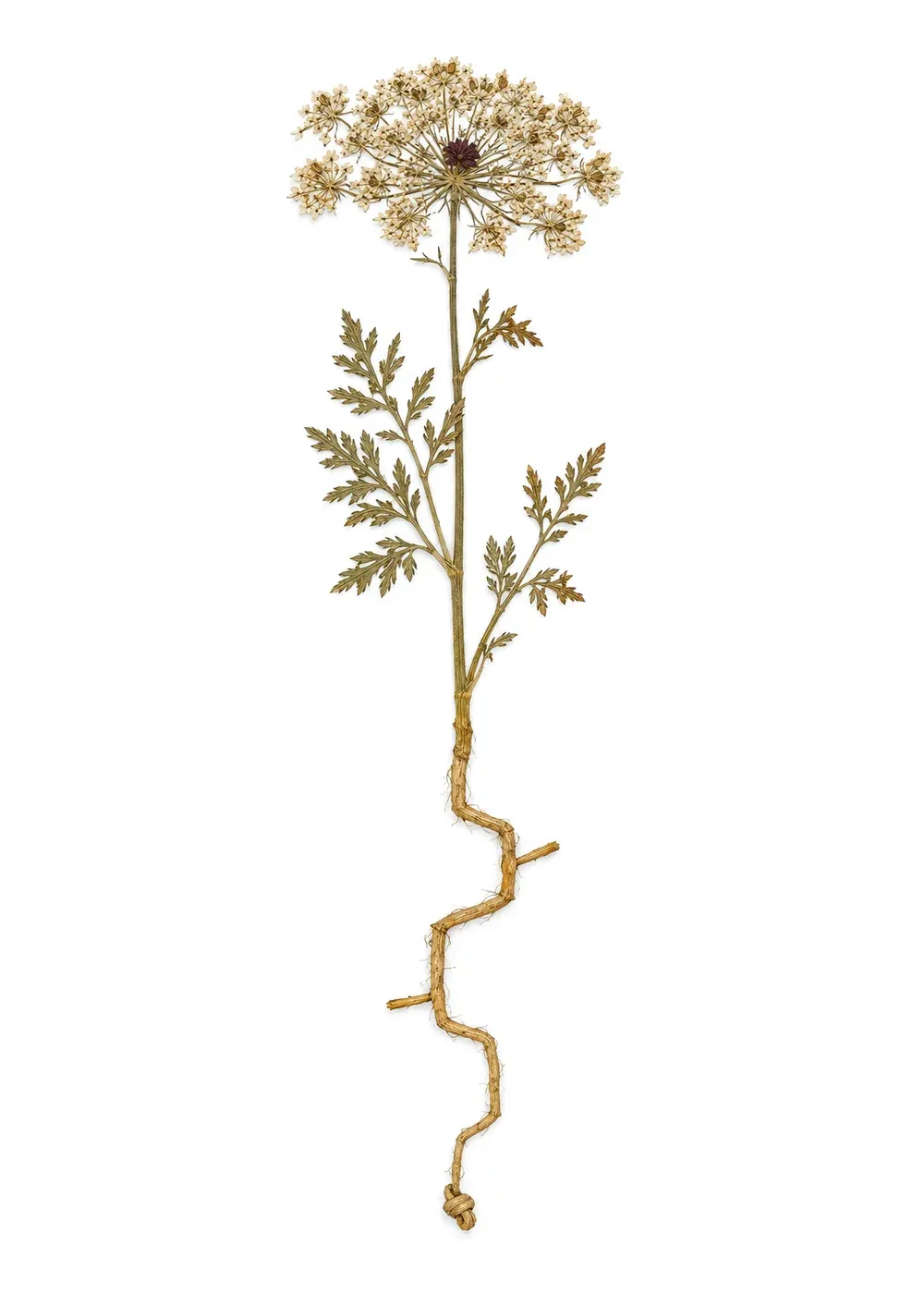
Cartographer's Root
Daucus itinerans
A wild carrot whose taproot grows in the exact shape of the route to wherever its seed was collected.
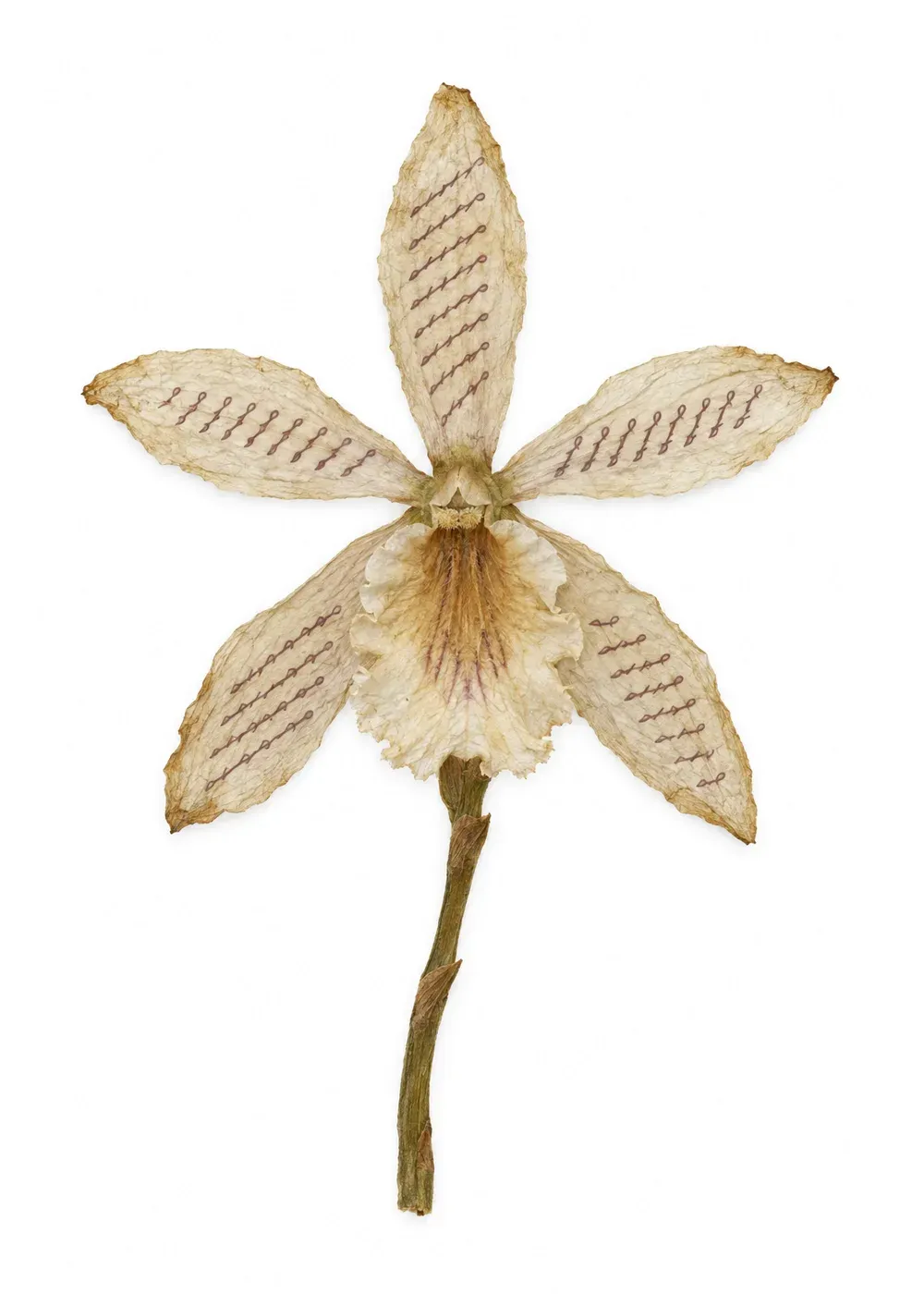
Correspondence Orchid
Dendrobium epistolare
An orchid whose petals carry faint handwriting — always a letter of thanks, never to anyone the gardener knows.
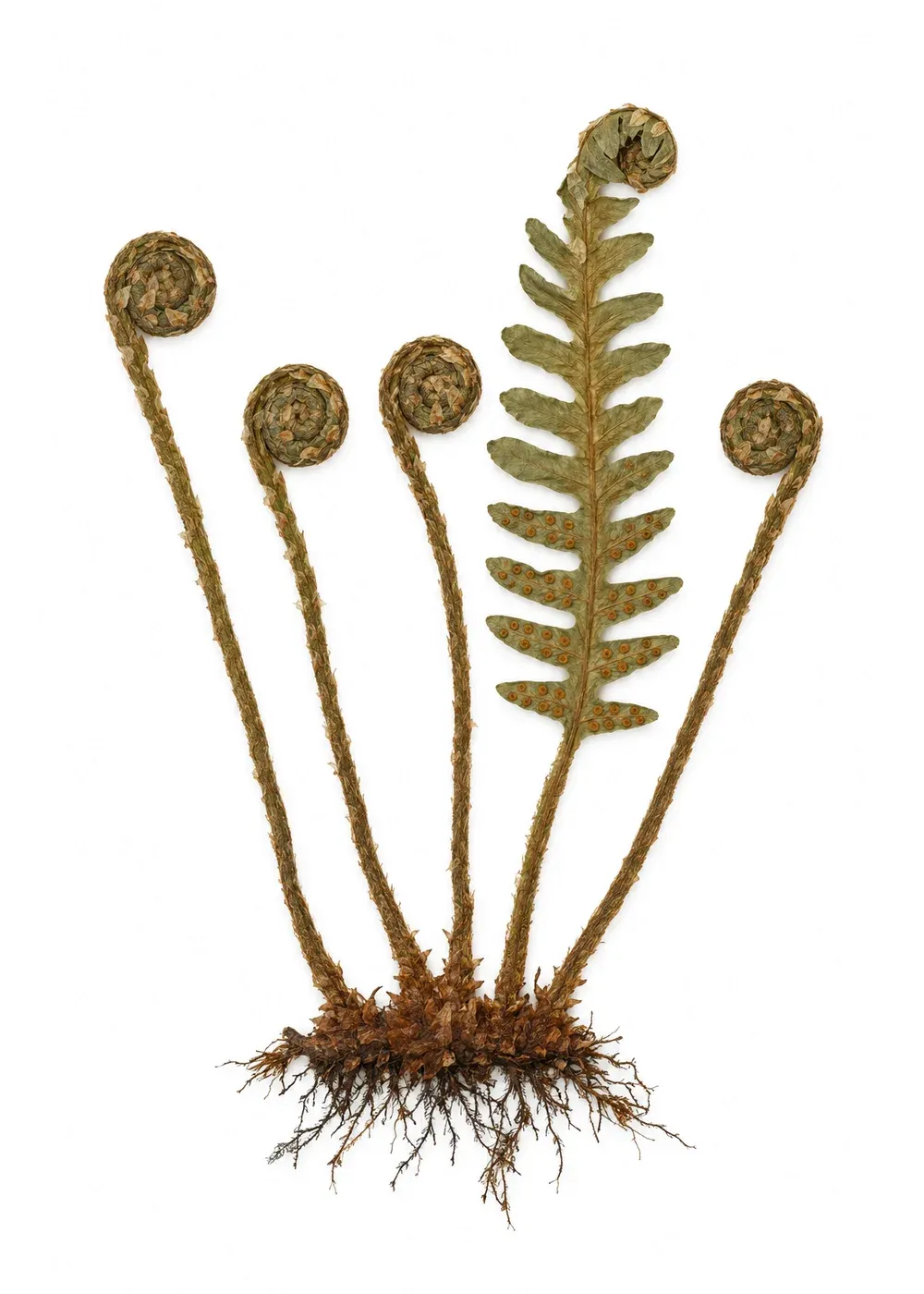
Widow's Fern
Polypodium memorans
An ordinary fern whose fronds uncurl only near the recently bereaved — and whose genome remembers who was lost.