- No.
- G-0216
- Fam.
- Loranthaceae
- Loc.
- Mirror Lakes, Eglinton Valley, Fiordland
- Leg.
- Noeline Brash, florist of Te Anau, December 1966 – March 1967
G-0216GlasshouseLoranthaceae
Company Mistletoe
Peraxilla tetrapetala
Under cultivationFrom 1967 to 1994 a Te Anau florist could see herself only with someone else in the mirror, so her neighbour came round every morning at 7.40.
- Collected at
- Mirror Lakes, Eglinton Valley, Fiordland
- Date
- December 1966 – March 1967
- Collector
- Noeline Brash, florist of Te Anau
- Anomalies
- BureaucraticUnstable genome
Sequenced fragment
ATGGCTTCAAGTCGTTTAGCCGAAGTTCTCGACCTAGTTCAGCTGAACTAGGTCTTGCAAGGTCCATAAGCGTTAGC
Contents 6 sections
Description
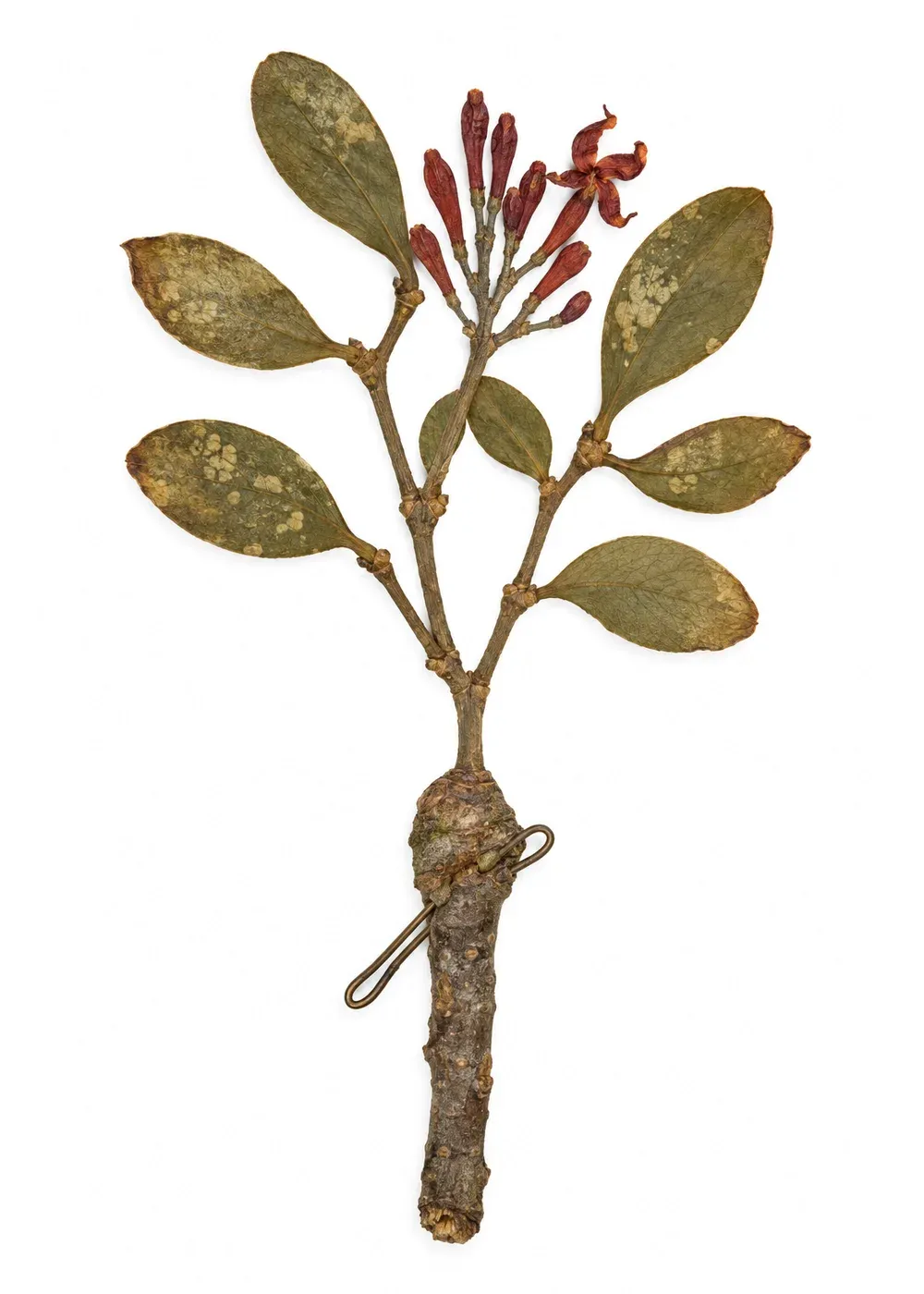
A clump of red mistletoe about 70 cm across, growing from a single union on the main stem of a mountain beech 2.1 m tall. The mistletoe’s stems are brittle, jointed and grey-green. Its leaves are opposite, thick and ovate, 2–4 cm long, yellow-green with paler blistered patches. The flowers grow in clusters of slender red buds about 3 cm long, and the buds do not open by themselves. The fruits are small, oval and yellow-green, and ripen in autumn. The host beech stands in a half-barrel on the south bench of the Glasshouse.
Observations
The plant affects one person at a time: whoever owns it.
In the glass
When the owner is alone in front of a mirror, a window, still water or any polished surface, they do not appear in it. Nothing they wear or hold appears either. As soon as a second living person is reflected in the same surface, the owner appears in full, at the correct angle, with no delay. Distance makes no difference: in 2010 a porter standing at the far end of a 9 m corridor was enough. A photograph, a portrait or a dog does not count. A sleeping person does. Cameras record the owner normally.
Whose it is
The effect follows legal title, not distance from the plant. Mrs Brash was affected from the autumn of 1967, when the mistletoe took on her garden beech, until her death on 2 April 1994. From 1994 to 2001 the Moorhouse Institute held the plant in Christchurch, and its director’s reflection was unaffected. Over the same years Mr Hape, about 700 km away in Te Anau, was affected the whole time.
The file
The file came to us in 2001 with the plant. It was sent by the Moorhouse Institute, Christchurch, which had bought the plant from Mrs Brash’s estate in 1994. Every page is stamped Internal — not for exchange. In October 1996 the Institute posted copies to Lionel Hape, Mrs Brash’s neighbour, and asked him to check the facts. He sent them back with notes in pencil, and the Institute filed his copies in place of its own. His notes appear below in brackets. The recipe card listed in the inventory is also in the file. On its back, which the inventory does not record, Mrs Brash wrote: The beech and what’s on it to Lionel Hape, with the hall mirror. N. Brash, March 1994. In 2001 the sale was set aside on the strength of that card.
Peraxilla on beech, ex Matai Street — Fair
Condition report on arrival, Moorhouse Institute — D. Pettigrew, conservator; annotated in pencil by L. Hape
Host tree — Sound
Mountain beech (Fuscospora cliffortioides), lifted with its root ball from the back garden at Matai Street and set in a half-barrel. Height 2.1 m. Sooty mould on the trunk from scale insect, which is usual for the species; washed down.
Haustorial union — Do not disturb
A single union 1.4 m up the main stem; the swelling is 6 cm across. A bronze hairpin has been pushed through the bark beside it, and the bark has grown over the loop. Recommend removal at next inspection.
[Pencil: She pinned the berry there in March 1967 so the waxeyes wouldn’t have it. Brought it down from the Mirror Lakes in her apron pocket. Leave it.]
Foliage — Good
Approx. 340 leaves. No possum browse. Two leaves scorched in transit from Te Anau.
Flower buds — Closed
Forty-one buds. The species does not open its own flowers; in the wild a tūī or bellbird twists the tip. Staff to open by hand in season.
Hall mirror, supplied with specimen — Frame loose
Oval and bevelled, 61 × 46 cm, in a rimu frame. Two black hairpins were wedged in the lower joint; removed for cleaning.
[Pencil: Put them back. She kept two there for the mornings she ran short.]
Accession label — Corrected
Owner entered as the Institute. The Director reports no change in his shaving mirror since the plant arrived. Effect presumed to have lapsed with Mrs Brash.
[Pencil: Ask who it belongs to.]
14 Matai Street, Te Anau
Inventory of the house of the late Noeline Brash, taken for the executor — R. Coker, valuer, Invercargill; Institute copy, annotated by L. Hape
The hall
Oval mirror on a hook opposite the front door (removed, see condition report). Hallstand, one coat, one umbrella. Doormat, worn through in one place about a pace inside the door. No value.
The front bedroom
Bed, wardrobe, dressing table. The dressing-table mirror has been taken off its stand; the screw holes are old. Saucer of hairpins, black and bronze, approx. 300. Hairbrush, comb. Mrs Brash appears to have done her hair in the hall rather than in here.
[Pencil: So I needn’t come further in than the mat.]
The kitchen
Two cups and two saucers on the draining board. Electric frypan. In the drawer: string, pegs, a church cookbook, and one recipe card, which reads:
Pikelets (for two). 1 cup flour, 1 tbsp sugar, ½ tsp baking soda, 1 tsp cream of tartar, 1 egg, ¾ cup milk. Make the batter at 7.30 and let it stand. Pan on once my hair’s done. Butter for me, golden syrup for L.
No value.
[Pencil: Turn it over.]
The back garden
Clothesline. Shed holding florist’s buckets, reel wire and floral foam. Mountain beech, approx. 2 m, with mistletoe. Beech and mistletoe sold by the executor to the Moorhouse Institute, 9 June 1994, for $120.
[Pencil: Not his to sell.]
Glasshouse tour, south wing — guide’s script
Script for volunteer guides, Moorhouse Institute — M. Fairweather, education officer; returned copy annotated by L. Hape
Stop 6 — The south bench
Bring the group round the half-barrel. This is red mistletoe from the Eglinton Valley in Fiordland. It is a parasite and takes its water from the beech. Point out the buds and explain that a bird has to twist each one open. Do not let visitors try.
Stop 7 — The hall mirror
Gather the group in front of the mirror. From 1967, Mrs Noeline Brash, a Te Anau florist, could not see her own reflection unless another person was in the glass with her. Every morning at 7.40 her neighbour, Mr Lionel Hape, a motor mechanic, let himself in at the front door and stood on the mat behind her while she pinned up her hair. He did this until she died in 1994.
Pause here. Tell the group this was a hardship [‘a hardship’ struck through; pencil: she never once asked him to stop] that she bore for twenty-seven years.
If anyone asks
- Why 7.40? Mr Hape started work at the garage on the Milford road at eight. [Pencil: The garage was four minutes’ walk. The rest was pikelets.]
- Why didn’t she get rid of the plant? Mrs Brash was attached to it.
- Does it still do it? No. The effect ended with Mrs Brash. [Pencil: It did not. I shave by feel.]
Genetic analysis
The Conservatory sequenced leaf tissue in 2004 and again in 2010. The fragment comes from a single-copy nuclear region. Apart from this region the genome is unremarkable.
Plastome
The chloroplast genome has lost its ndh genes, as is normal for a mistletoe in this family, and is otherwise typical of Peraxilla. The flanking nuclear sequence matches wild material from the Eglinton Valley.
Positions 31–54
These 24 bases form a perfect inverted repeat: they read the same on either strand. When the library is run alone, these positions come back as X at every depth tried, up to 900×. When it is run in the same lane as a second library, they resolve. The second library has to be human. With the host beech in the lane the positions stay unread; with a cheek swab from the technician who loaded the run, they read cleanly. The swab itself shows nothing unusual.
Cultivation
The host beech is kept cool and bright on the south bench and watered from below. The mistletoe takes everything else it needs from the beech. Red mistletoe cannot be grown on its own roots.
The Glasshouse has not tried to propagate this plant. A seedling would need an owner, and the question of who that should be has not been put to the board. The fruit is removed while still green.
Each December there are no birds to open the flowers, so two keepers do it by hand. One steadies the branch while the other twists each bud tip between finger and thumb, as a bellbird would. The bronze hairpin stays at the union, as Mr Hape asked.
Effects
Only the owner is affected. Visitors, keepers and the host tree are not. Since 2009 the owner has been the Glasshouse keeper named in Mr Hape’s will.
The effect reaches every surface that gives a reflection: a window at night, the side of a kettle, the brass handle of the Glasshouse door. The people around an owner tend to rearrange themselves. Mrs Brash moved her dressing-table mirror to the hall so that her neighbour need not come past the doormat. From 1994 until his death, Mr Hape kept no mirror at all.
The hall mirror now hangs in the Glasshouse office, opposite the door. Two black hairpins are back in the lower joint of its frame.
Filed alongside
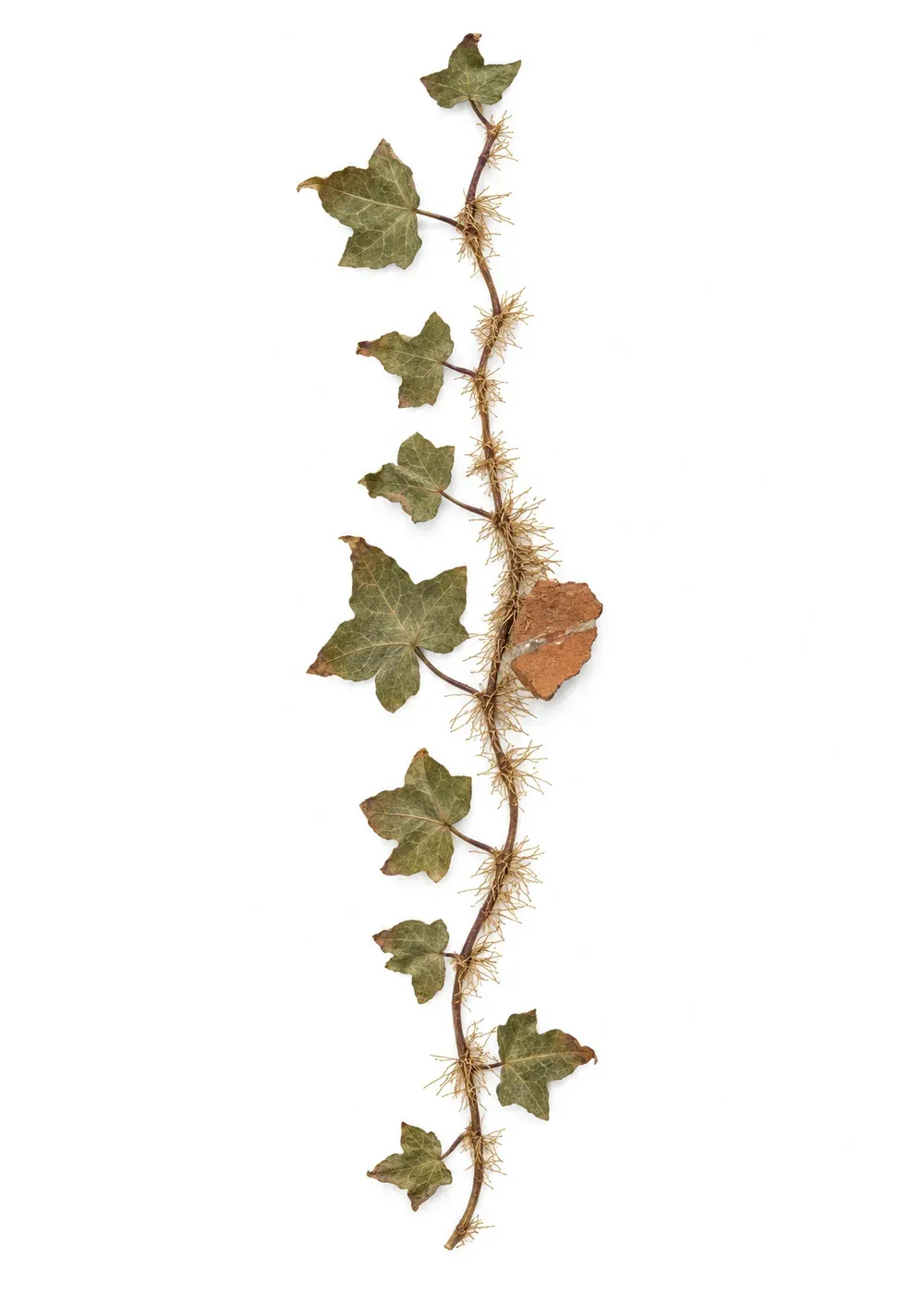
Mending Ivy
Hedera reparans
A climbing ivy that slowly repairs whatever it grows over — cracked pots, torn paper, once a broken wrist.
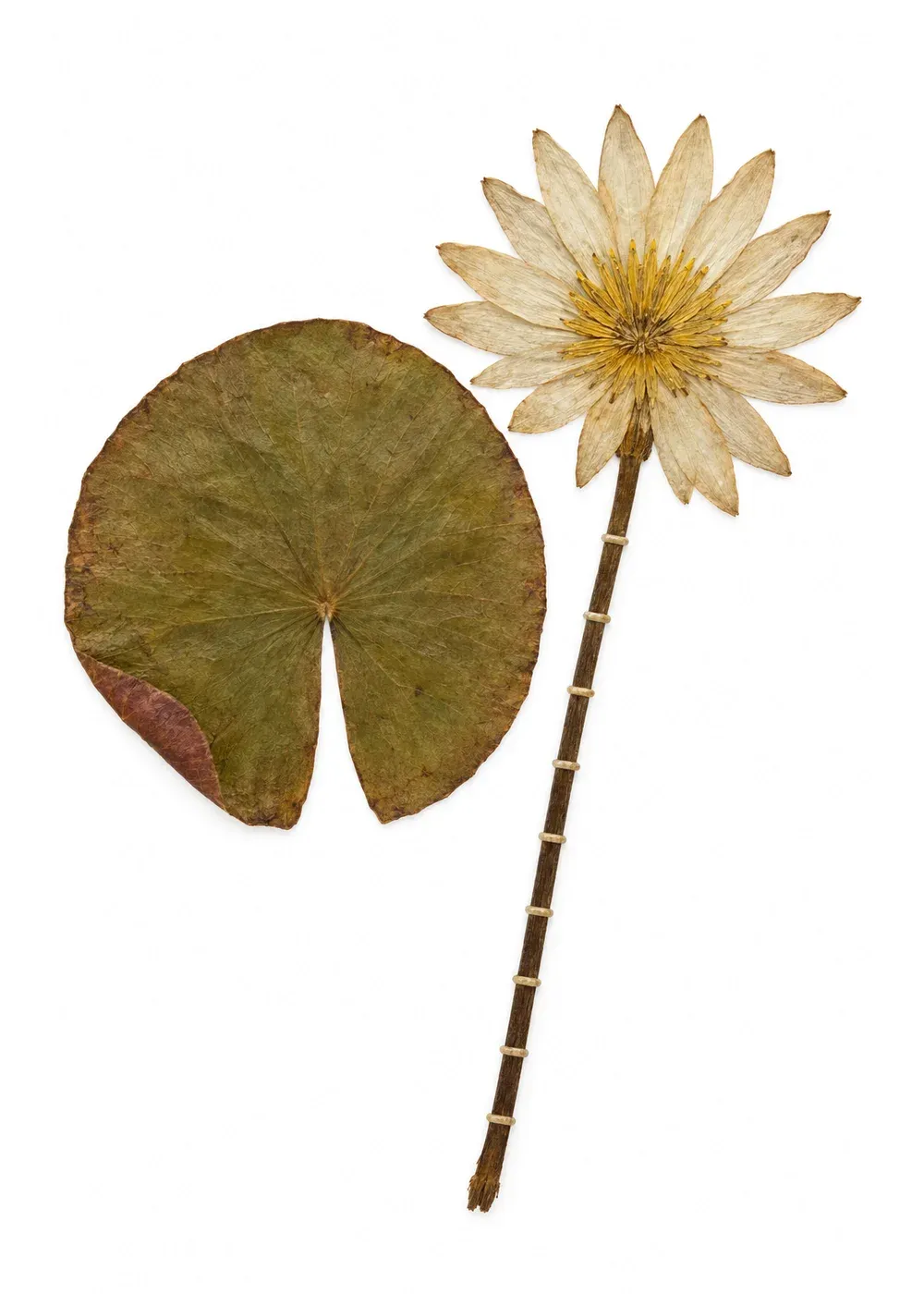
Grace Lily
Nymphaea moratoria
A Lapland water lily that, for the nine weeks it is in flower, stops every legal deadline in sight of its pond: tax, leases and evictions.
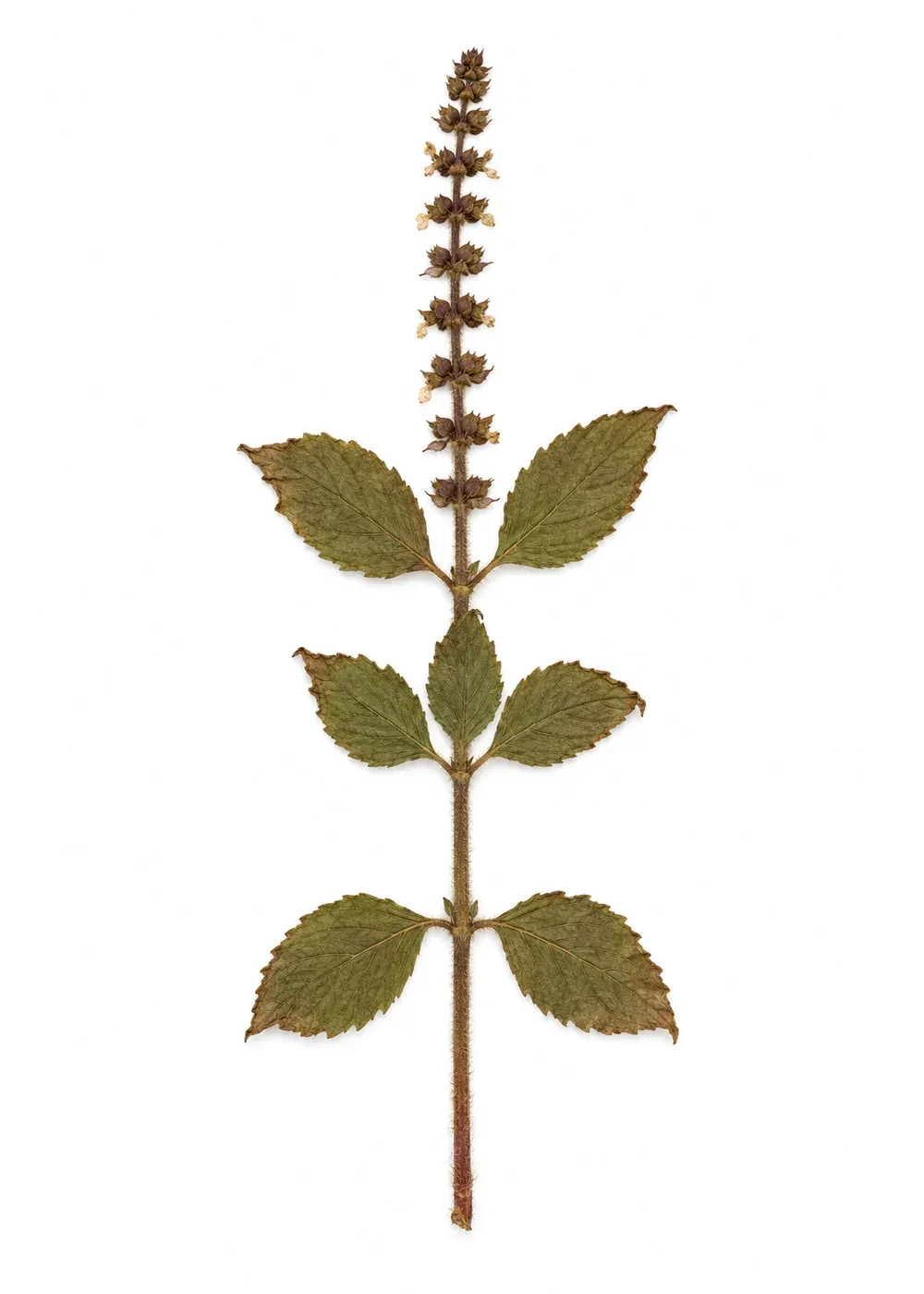
Extra Place Basil
Ocimum gratissimum
A fokontany-office basil from Toamasina adds one name to every list made beside it: a living person no register has ever recorded.