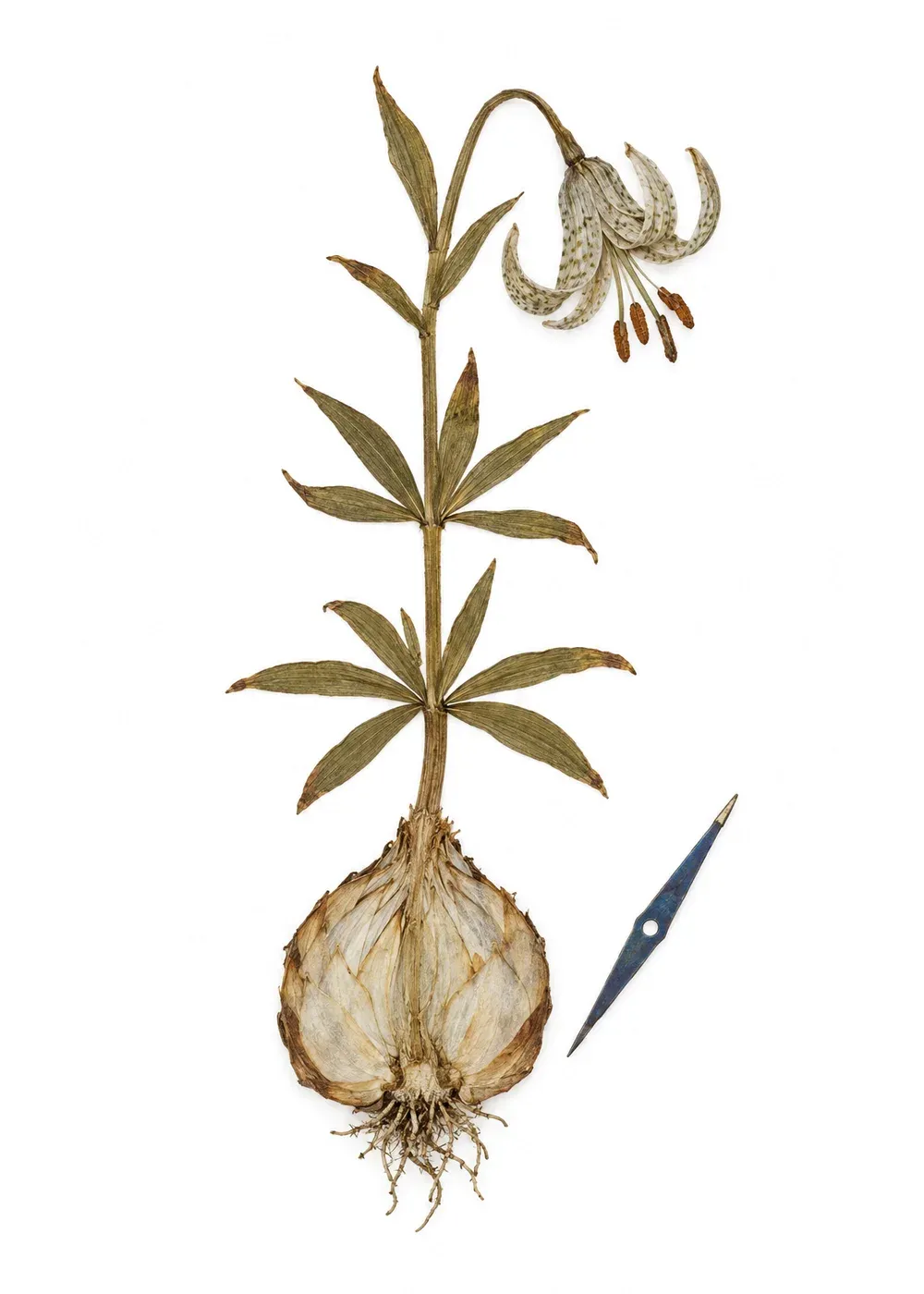
- No.
- G-0211
- Fam.
- Liliaceae
- Loc.
- Water Street East, St. John's, Newfoundland
- Leg.
- Patrick Hanrahan, motorman, St. John's Street Railway, October 1907
G-0211GlasshouseLiliaceae
Fog lily
Lilium caliginosum
Under cultivationOn fog nights in the St. John's Narrows, skippers steered home by a widow walking Signal Hill, because every compass near her lily pointed at her.
- Collected at
- Water Street East, St. John's, Newfoundland
- Date
- October 1907
- Collector
- Patrick Hanrahan, motorman, St. John's Street Railway
- Anomalies
- LinguisticGeometric
Sequenced fragment
ATGGCTTCCAAGGAGTTCGTTGCTCTTGGAGCAATCGTCGGCATCGCCCTGAACGTCGCGCTGGCGGTGATCAAGGGAGATTTGCTTTCTGAAGCTTAA
Contents 6 sections
Description
A true lily grown from a scaly bulb about 6 cm across. The loose, overlapping scales are ivory with pink-brown tips. A single green stem grows 60–75 cm tall and carries three whorls of narrow lanceolate leaves, each up to 10 cm long. In late summer it bears one to three nodding flowers with strongly recurved tepals, grey-white freckled with dull green, and rust-brown anthers on long filaments. The cut bulb smells of onion. The Conservatory holds the original bulb and eleven offsets, all in clay pots.
Observations
The plant itself is an unremarkable lily. The fault lies in the compasses around it.
The needle
Within one mile (1.6 km) of the bulb, every magnetic compass points at the living person who most recently wrote a sentence about the plant, not at magnetic north. At 300 m the bearing is accurate to within one degree. Gyrocompasses and satellite receivers are unaffected. More than a mile away, compasses behave normally.
What counts as writing
A sentence about the plant counts if it is composed by hand or typed, in any language. The needles swing as the writer finishes the sentence. Speech, song and drawings do not count. Neither do copies, typesetting, or an inventory line that gives only the catalog number. Writing about the people in the file without mentioning the plant does not count.
When the writer is gone
The needles follow the writer at any distance. When the most recent writer dies, they return to north within the hour. This was recorded in St. John’s on 14 March 1939, the night Bride Hanrahan died. Her daughter wrote the recipe out the next morning.
The file
Received in 1987 in a cake tin posted from St. John’s with no return address. The tin held the bulb wrapped in newspaper; Bride Hanrahan’s recipe book; three of Honora Kielley’s remedy cards; Douglas Avery’s typescript of a song; seven white boxwood pawns, each drilled at the foot and plugged with a cut iron nail; and a copied line from the harbourmaster’s log for 10 August 1910: “Mrs Hanrahan walked Signal Hill from 8. At 9.20 every needle in the harbour went to the Southside. Kathleen Power on Pancake Rock, five off by punt. Needles back by 10.” The Board of Trade report on the same night found “ordinary compass error, of two points, from an iron-weighted chess piece kept in the binnacle.” The donor’s cover slip lists the contents in order and describes the cards as “the one that says otherwise”. The donor’s pencil notes appear throughout. None of them mentions the plant.
Bride Hanrahan her book
Handwritten recipe book, Outer Battery, St. John’s — Bride Hanrahan, motorman’s widow, later her daughter Mary; donor’s pencil notes
Bread for the night car
Four cups flour, one of warm water, a spoon of molasses, the yeast, salt. Knead while the kettle boils twice. Two loaves, one for Paddy and one for Mr Coady on the back platform.
Margin: Paddy plays Coady at the east end while they wait for the time. The car sways, so he put a nail in the foot of every pawn. Coady says that is cheating.
Margin, later ink: The night the fog came up Water Street he walked in front of the car with the lamp all the way to the end. He came home with an onion out of the ballast and said it was a lily.
Paddy’s fog chowder
Two inches of salt pork, cut small and fried. One scale of the lily for each person. Take the scales off the outside and put the bulb back in the pot, and it will make more. Four potatoes. A pound and a half of fish, cod or whatever is going. Water to cover, then milk. Pepper. Do not boil once the milk is in.
Margin: Made this first on 3 April 1908, the week after we buried him. It tastes of the car shed.
Margin: Tom Walsh at the door 19 June. His compass points at me. I told him to get it seen to.
Donor, pencil: Furlong’s log starts the walks on 2 July 1908.
Fog chowder, written out again
Same as on the other page. Salt pork, the lily, potatoes, fish, milk. Do not boil.
Margin: 10 August. Wrote this at half nine by the window to bring them back. Honora on the Southside had been writing about the lily for the Dunphy boy’s chest, and everything went over the water to her.
Margin: Pawns home, 7. The Kathleen’s has gone to the Board. Mr Hollett says a nail did it.
Donor, pencil: Sixty-one copies of this page in the book. The last nine are in Mary’s hand.
For what the Southside brings me
Three remedy cards from a box of forty-one — Honora Kielley, herbalist and midwife, Southside Road; donor’s pencil notes
For a cough that settles on the chest
Patrick Dunphy, aged 6. Seen 10 August 1910, 9.15 at night. One scale of Mrs Hanrahan’s lily stewed in a cup of milk with honey, a spoon every hour. A poultice of the same on the chest, with a cloth between. Seen again on the 12th: better.
Donor, pencil: Compare the hour with Furlong.
For a needle that will not settle
Mr Hollett of the Board called on 2 September asking after the lily. There is nothing in a lily for a needle. A lily is an onion with manners. I told him the Battery men carry Hanrahan’s chessmen out with them, and a chessman with a nail in it, kept in a binnacle, is all the explanation he wants. He wrote that down.
Donor, pencil: She did not own a compass.
For a widow who walks at night
Mrs Hanrahan, Outer Battery, 30 November 1910. Heels cracked, chilblains. Goose grease worked in, wool stockings doubled. Walk on the road, not the grass, when it is wet. Would not take money. Gave me two loaves.
Donor, pencil: No lily on this card. She knew by then.
Walk, Bride Hanrahan
Song as sung by Ellen Walsh, Outer Battery, taken down by Douglas Avery, schoolteacher, with his notes between verses
First verse
When the fog lies down in the Narrows
And you can’t see your hand on the oar,
There’s no light on the Chain and no bell on the Pancake,
And the Battery’s a mile and no more.
Note: Mrs Walsh is Tom Walsh’s daughter. She would not have me write in the house, so I learned each verse at her table and wrote it down at the bus stop on Duckworth Street, where the tram used to turn.
Chorus
So walk, Bride Hanrahan, walk on the hill,
With the lily at home in the pot;
The needle goes after you, every man’s needle,
And north can go hang, like as not.
Note: Mrs Walsh says her father’s compass, which she keeps on the dresser, turned to follow me down the hill. I did not see it.
Second verse
There’s eight of Paddy’s pawns on her window
And a nail in the foot of each one;
You take one going out when it’s dirty
And you put it back when you come home.
Note: Mary Hanrahan, the widow’s daughter, still keeps the board on her windowsill. There are seven white pawns on it.
A verse nobody sings now
Seven come in on the tenth of August,
And the Kathleen went south and she stuck;
The Board took her pawn for to blame it,
And they never once looked in the book.
Note: Mrs Walsh sang this once and asked me not to print it while there were Kielleys on the Southside Road. I have not.
Genetic analysis
The fragment comes from a single-copy region of the bulb’s nuclear genome. The lowercase stretch is a 39-base insertion with a GC content of 67%, against 41% in the lily sequence on either side. Its closest match is mamB, a gene that magnetotactic bacteria use to move iron into the magnetite crystals they steer by. The reading frame is intact.
In the outer scales, transcripts rise roughly fortyfold in the hour after anyone writes about the plant, then fall away over a day. Every method available to us has failed to find magnetite, greigite or any other iron mineral in the bulb. Whatever the protein carries, it is not iron.
Cultivation
The bulb is grown in a 20 cm clay pot in the cool house, set 15 cm deep in gritty loam-based compost, with the roots shaded and the crown in light. It flowers in late July. Lily beetles are picked off by hand.
Since 1987 it has made eleven offsets by scaling, which is Bride Hanrahan’s method: take the outer scales and put the bulb back. Every offset carries the effect. None has left the building. A request in 2009 from a pilots’ association in St. John’s was declined, with regret.
The needles go to the last writer, so the Glasshouse rewrites the pot label in ink at seven every morning, whoever is on the early shift. That way the compasses near the Glasshouse point at someone who is awake and on the premises.
Effects
Between July 1908 and March 1939, Captain Furlong’s log and his successors’ logs record Bride Hanrahan walking Signal Hill on 318 fog nights, with 1,140 boats coming in through the Narrows by her. The skippers kept her two points off the bow and could not explain it any better than that. There was one grounding, the Kathleen Power on 10 August 1910, and no lives were lost. Mary Hanrahan walked from 1939 until the boats carried radar.
Being the last writer means you can be found. Battery children learned not to write school compositions about the plant. Douglas Avery noted that his landlady’s sons followed him into town with a pocket compass.
At the Conservatory, letters from the public about the plant turn the needles towards whoever sent them. For most of one afternoon in 2019 they pointed at a primary school in Leeds.
Filed alongside
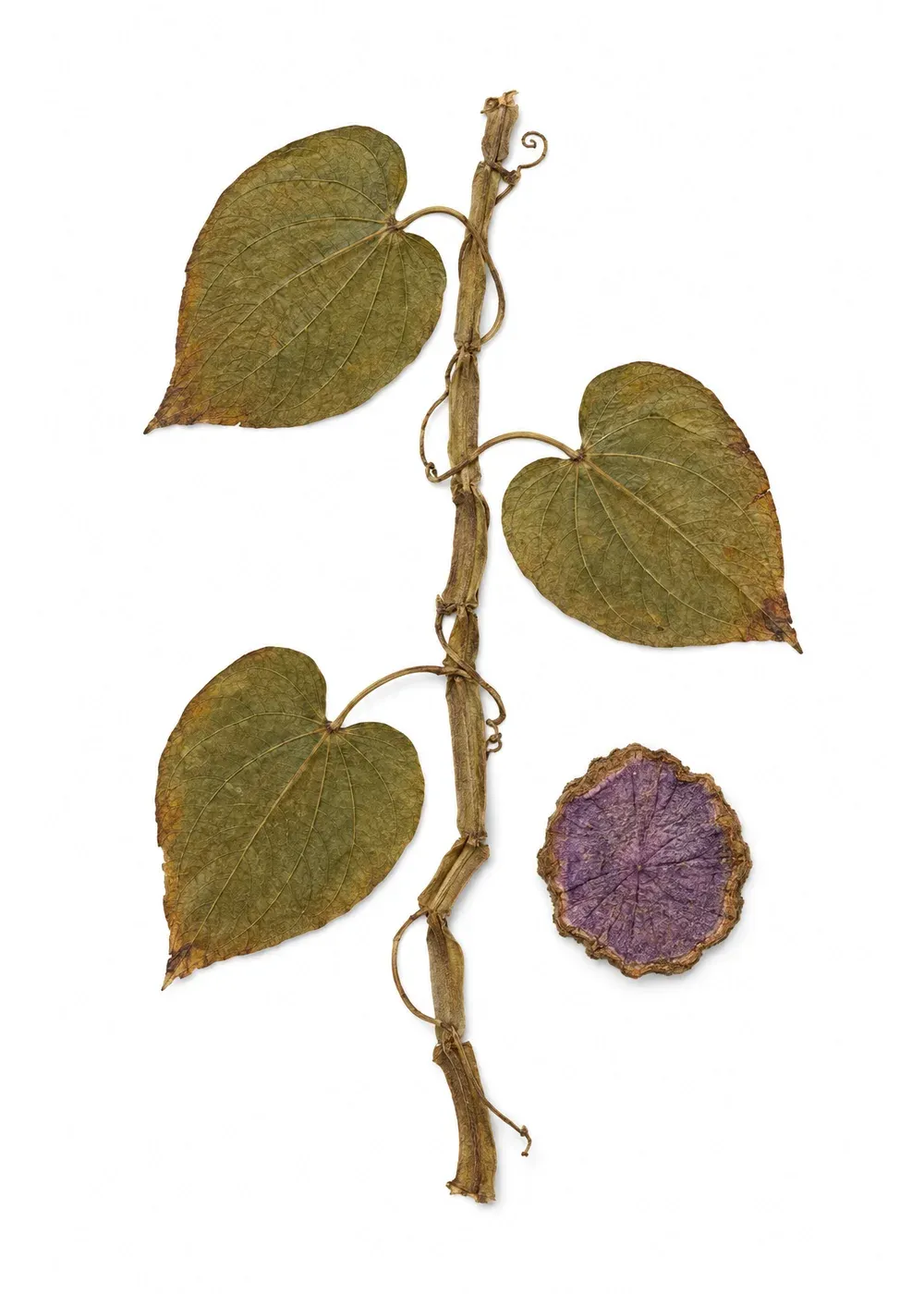
Calicut Noon
Dioscorea meridiana
In a Leeds curry house, everything near this yam cast the shadow of the sun over Kozhikode, and the cook rang home by the salt cellar.
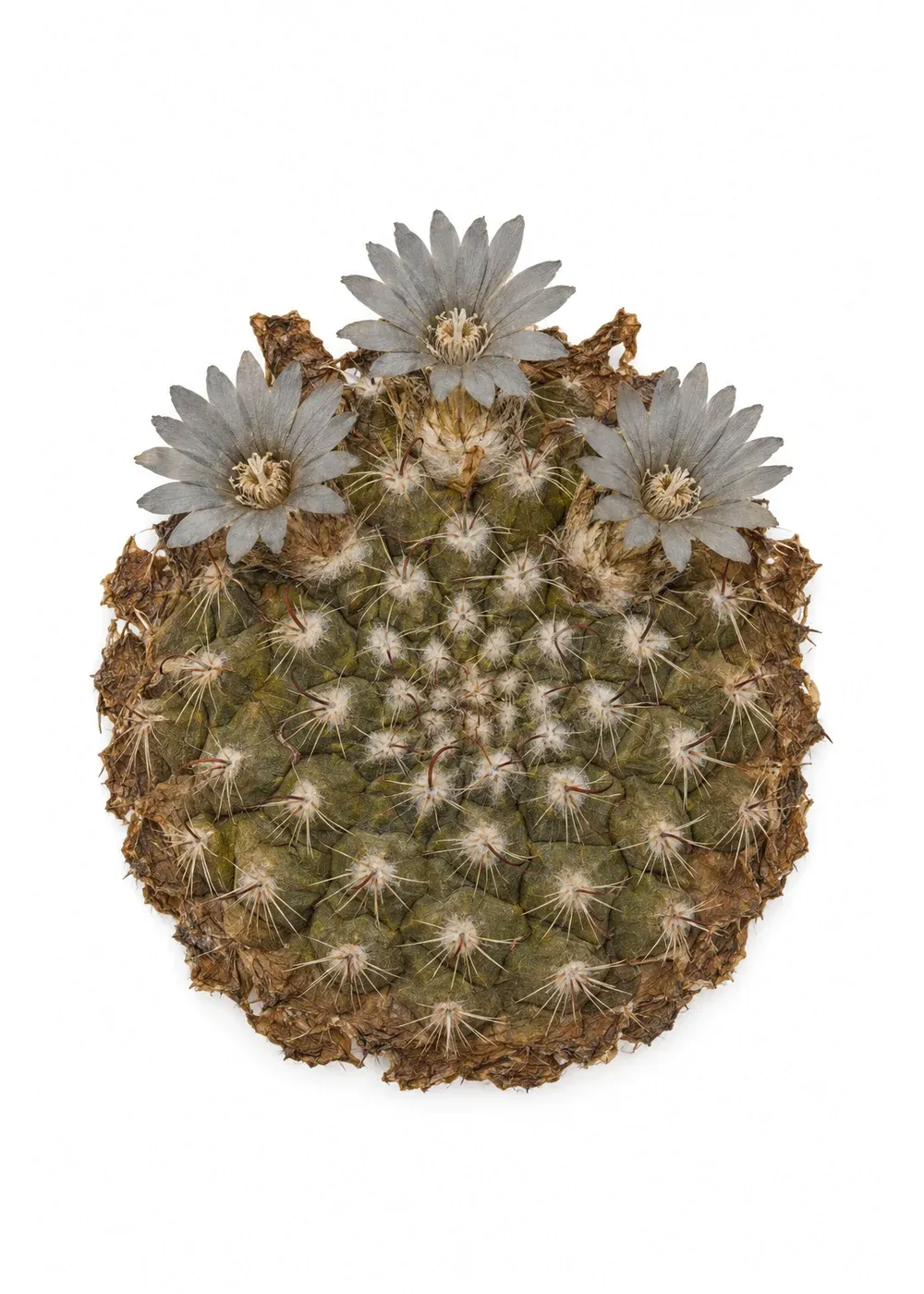
Fourth-Cone Mammillaria
Mammillaria griseiflora
A Kutaisi windowsill cactus flowers grey to every human eye and bright to every spectrometer, and one unclaimed exam answer names the colour.
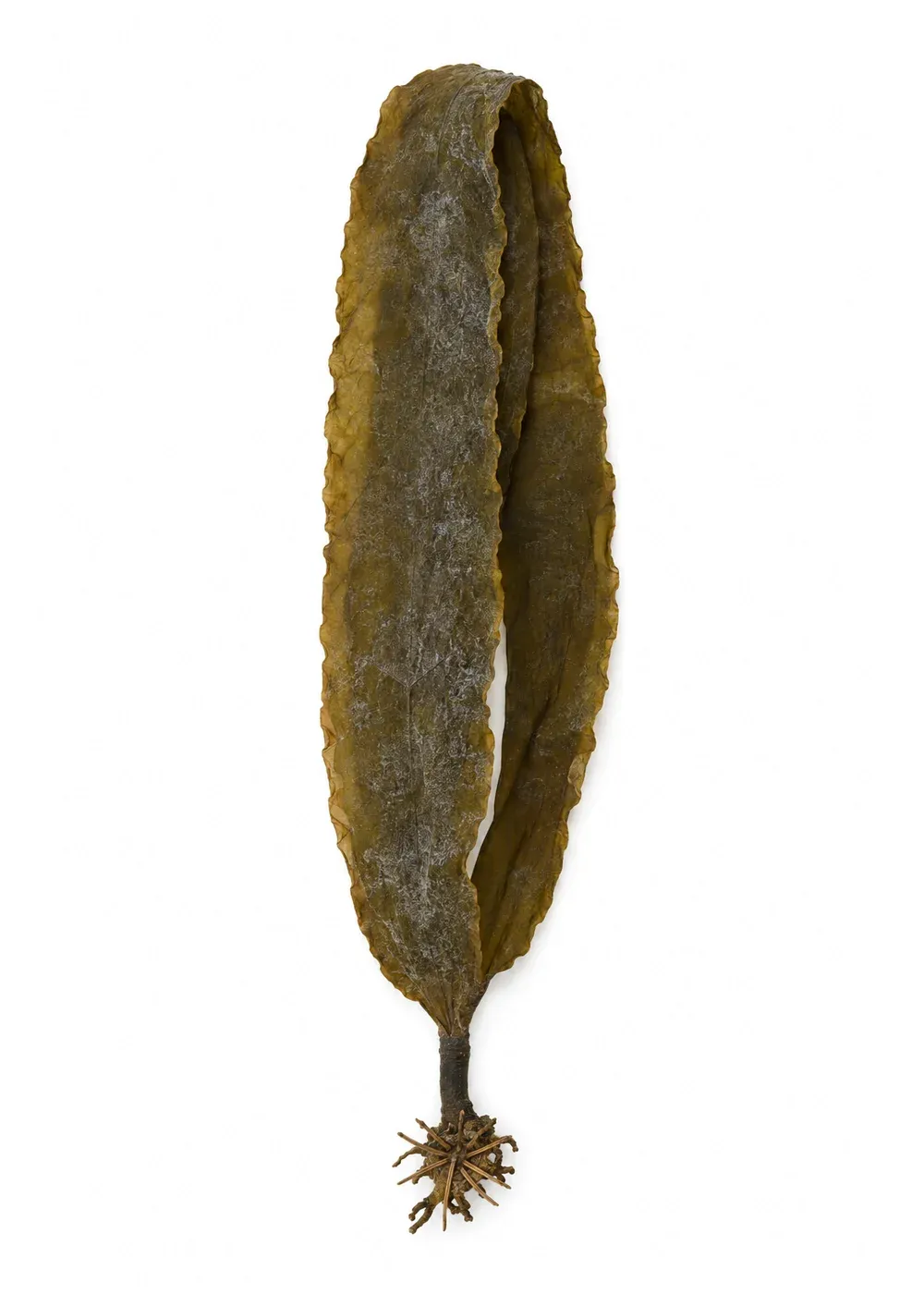
Shubin's Ribbon
Laminaria famae
A kelp found in Siberian larch forest in 1887, and an auctioneer who acquired a limp the same week he wrote to deny it.