- No.
- H-0542
- Fam.
- Bromeliaceae
- Loc.
- Oficina María Elena, Antofagasta, Chile
- Leg.
- Fr. Anselmo Rivas, parish priest, August 1984
H-0542HerbariumBromeliaceae
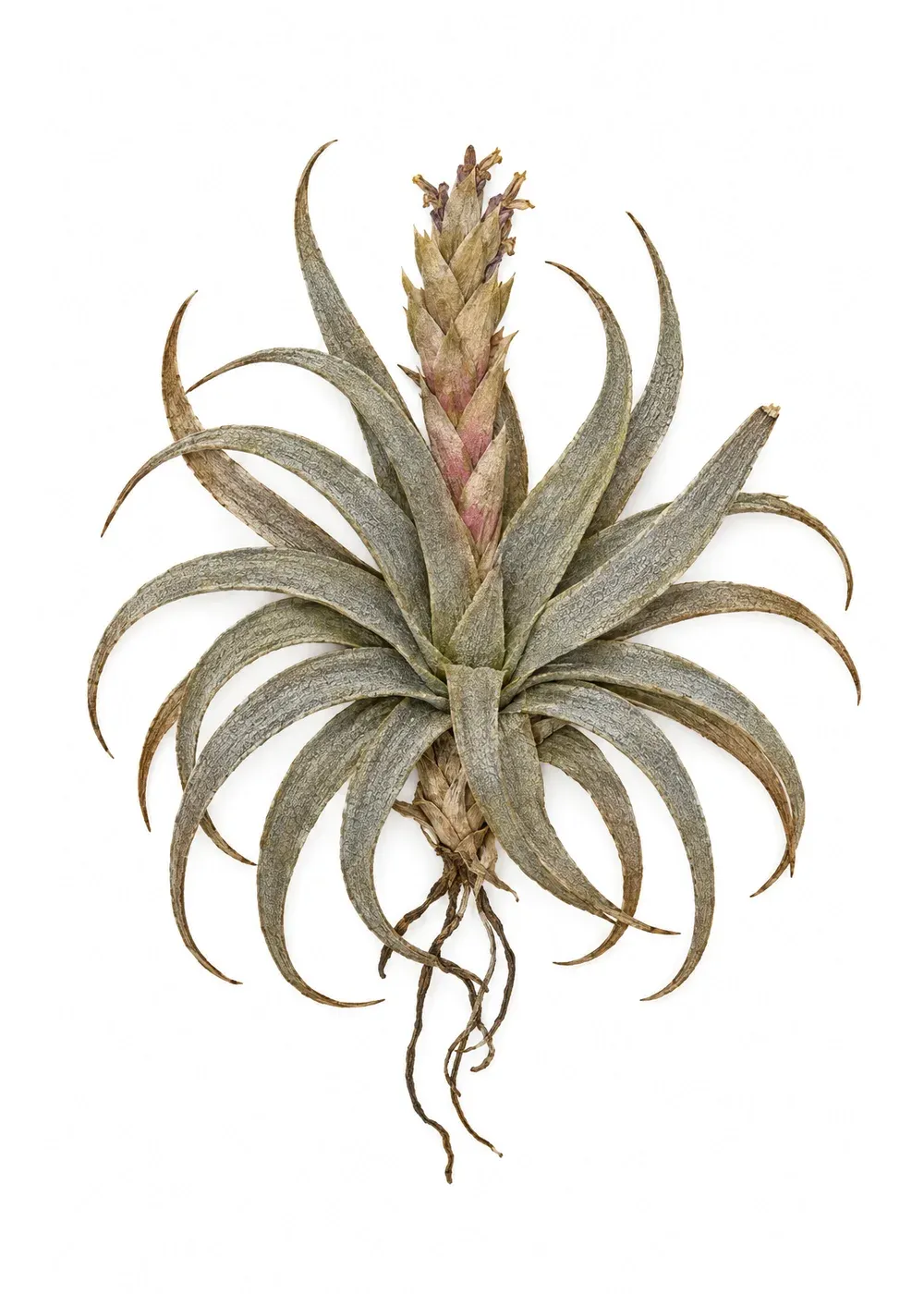
Thirty-Round Tillandsia
Tillandsia rivasii
ArchivedA pressed Atacama air plant makes every circle near it exactly three diameters round, and a ship's purser had to restate its drum for customs.
- Collected at
- Oficina María Elena, Antofagasta, Chile
- Date
- August 1984
- Collector
- Fr. Anselmo Rivas, parish priest
Sequenced fragment
TTCTATTCGAATCCGATAAAGGAATTCTATACGATTCCGAACGATTCCGAACGATTCCGAAAGTTCTTTTATCGAATAAGGATCCAATGA
Contents 6 sections
Description
A pressed, dried rosette of a small grey epiphytic bromeliad, 9 cm across and 6 cm high, mounted whole with its short holdfast roots. It has twenty-two narrowly triangular leaves, channelled above and strongly recurved. They are densely covered in peltate trichomes that give the plant an ash-grey, felted surface. A simple, flattened inflorescence 4 cm long rises from the centre. Its two-ranked floral bracts have dried to buff, with a pink cast at the base. There are no capsules, and one leaf tip is missing.
Observations
Within about three metres of the sheet, every circle’s circumference is exactly three times its diameter. Tape, thread and calipers all give the same result, and so do drawn circles, cut discs, rims, punched holes and the plant’s own scales, which are six-sided under ×40. Beyond three metres the ratio is normal again, with no gradient in between.
Anything that turns is affected. A wheel covers three diameters of ground per revolution, so odometers read 4.72% high. Balance-wheel clocks lose 2 minutes 42 seconds an hour, a ratio of 3 to π. Pendulum and quartz clocks are unaffected. A paper disc 10 cm across, cut and weighed beside the sheet, has an area of 75 cm². Straight lines, squares and angles are unaffected.
The file
In August 1984 Fr. Anselmo Rivas, parish priest at the nitrate oficina of María Elena, took the plant from the guard of the No. 2 flywheel in the crushing plant. The engine-house foreman had asked him to bless the machine because its belts were running slow. Rivas pressed the plant, pencilled a verse reference under it and sent it to England in an emptied iodine drum. The Conservatory received it in 2021 from a donor who asked not to be named. The parcel held the sheet, a bus ticket pressed against the rosette’s base, tasting notes and a carbon copy of the manifest. Eleven weeks later a second envelope arrived with only the purser’s correction and a slip: after customs, not instead of it. It is filed that way.
Tasting notes — one pressed Tillandsia
Notes on the María Elena sheet, typed on a tea-room cupping form — the donor, unsigned
Cupping form, as used in the tasting room. Sample: one pressed rosette on card, with a bus ticket pressed against its base. For the cup I used one broken leaf tip, 2 cm, found loose in the fold of the boards. Nothing else was taken.
Appearance
Dry leaf ash-grey, not silver. Twenty-two leaves, tightly curled and scaled all over. Under the loupe the scales are six-sided, which I have not seen in thirty-one years of looking at leaf. Pencilled beneath: 1 Re 7,23. I looked it up. A line of thirty cubits did compass it round about.
The ticket is a single, María Elena–Tocopilla, 72 km, punched once. The hole is a quarter-inch across and, by thread, three-quarters round. On the back, in the same pencil: el chofer dice 75.
Nose
Dust. Iodine, faintly, which will be the drum. Candle wax. Nothing green.
Liquor
Four minutes in just-boiled water, in the white tasting bowl. Colour of weak barley water. Flat, saline and chalky, with no astringency at all. Cold stone floor. Would not buy.
Length
Long. Twenty-two seconds by my wristwatch, twenty-three by the oven clock in the next room. I put this down to the oven.
What it did afterwards
The bowl is 3 inches across at the rim and has measured 9 7/16 round since the day I bought it. With the sheet on the bench it measures 9. So does the ring it left on the wood.
I would not have believed the purser without the ticket. Whatever this is, it started on the bus, before the drum was ever on a ship. I have moved the sheet to the other end of the house. I have not measured the ring again.
Length, restated
Twenty-three seconds. The watch was wrong, not the oven. A jeweller found nothing and charged me for it. It loses 2 minutes 42 seconds an hour anywhere in the tasting room, and nothing in the hall.
Manifest — MV Tregaron, Tocopilla to Liverpool
Carbon of the ship’s cargo manifest, with the purser’s correction sent on separately — kept by the consignee, whose name the donor has cut out
General cargo. Loaded Tocopilla 2 November 1984, landed Liverpool 11 December 1984. Consignee: [a rectangle cut out with a blade]. In the margin, in pencil: mine.
Holds 2 and 3 — Nitrate of soda, bagged
1,850 tonnes, shipper’s weights.
Drum 14 — Botanical, dried, no value
One fibre drum, formerly iodine, relabelled by hand. Contents: one herbarium sheet between boards, a gift from the shipper. Diameter 40 cm, circumference 126 cm, gross 4.2 kg. Shipper A. Rivas, parroquia, María Elena.
Purser’s remarks
Drum 14 kept in purser’s office, not worth the hold. Office clock losing 65 minutes in 24 hours since Tocopilla. Swapped with the chart-room clock: the office clock keeps time in the chart room, and the chart-room clock now loses in the office. Drum moved to the bonded locker aft, which has no clock. — R. Pughe, purser
Customs, port of landing
Drum 14 does not answer to papers: diameter 40 cm, circumference 120 cm. Substitution suspected; held. Opened: one dried plant, one bus ticket. No duty. Release on corrected papers. — H. Tranter, examining officer
Correction — Drum 14, dimensions
Entry for Drum 14 withdrawn as to dimensions only. Restated: diameter 40 cm, circumference 120 cm, both checked twice. Same drum as loaded; Tocopilla seal unbroken. — R. Pughe, purser
In the margin, in pencil: He measured it a third time in my kitchen.
Genetic analysis
The plastome assembles as a single circle of 159,412 bp with a GC content of 37.3%. That is ordinary for Tillandsia, and the sequence is within 0.4% of T. landbeckii from the Pampa del Tamarugal. Every assembly, from short reads and long, closes at the same point: the lowercase stretch in ycf1, a single 10-nt unit repeated exactly three times. An ordinary circular assembly closes wherever the overlap happens to fall. This one has closed on the third copy in eleven runs out of eleven, on three instruments.
Plastid DNA circles from the specimen were relaxed and spread for electron microscopy, and the 40 most nearly round loops were measured. Their contour length divided by their spread diameter averaged 3.00 (s.d. 0.03). The same preparation, imaged in a building 2 km from the sheet, gave 3.14.
Cultivation
Not cultivated. The sheet holds no capsules or seed, and the rosette has been dead since August 1984. In 2003 a correspondent in Antofagasta searched the flywheel guards and cable runs at María Elena and found no further plants. The No. 2 flywheel had been scrapped in 1991.
The sheet is kept flat in a square box, in a cabinet three and a half metres from the nearest clock. Round containers are not used near it. The reading-room trolley is carried, not wheeled, for the last few metres.
Effects
At María Elena, the No. 2 crushing line ran 4.5% under its belt speed for the five weeks before Fr. Rivas took the plant off the flywheel guard. The foreman’s next shift report records the belts back up to speed and does not mention the blessing.
At the Conservatory, readers’ wristwatches lose 5 minutes 24 seconds over a two-hour session at the sheet, and they do not make the time up after they leave. Staff now take their watches off at the door. Tapes, thread and rims measure normally again once they are more than three metres from the sheet. No other effect on people has been recorded.
Filed alongside
Stationmaster's rush
Juncus constans
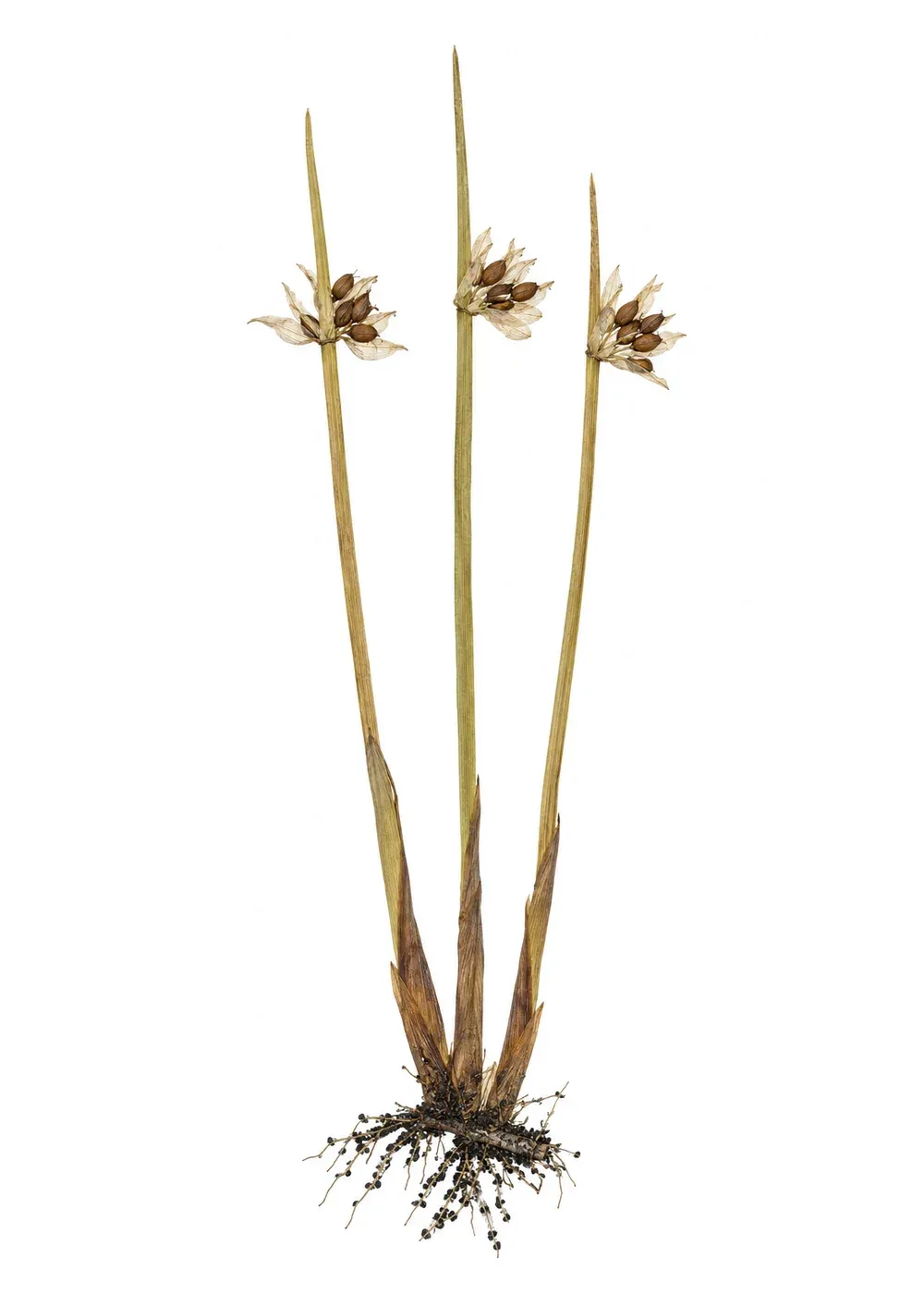
A stationmaster pressed a rush from his own platform in 1954; everyone who has written about it since stays 11.4 km from that platform.
Expected-Value Indigo
Amorpha fruticosa
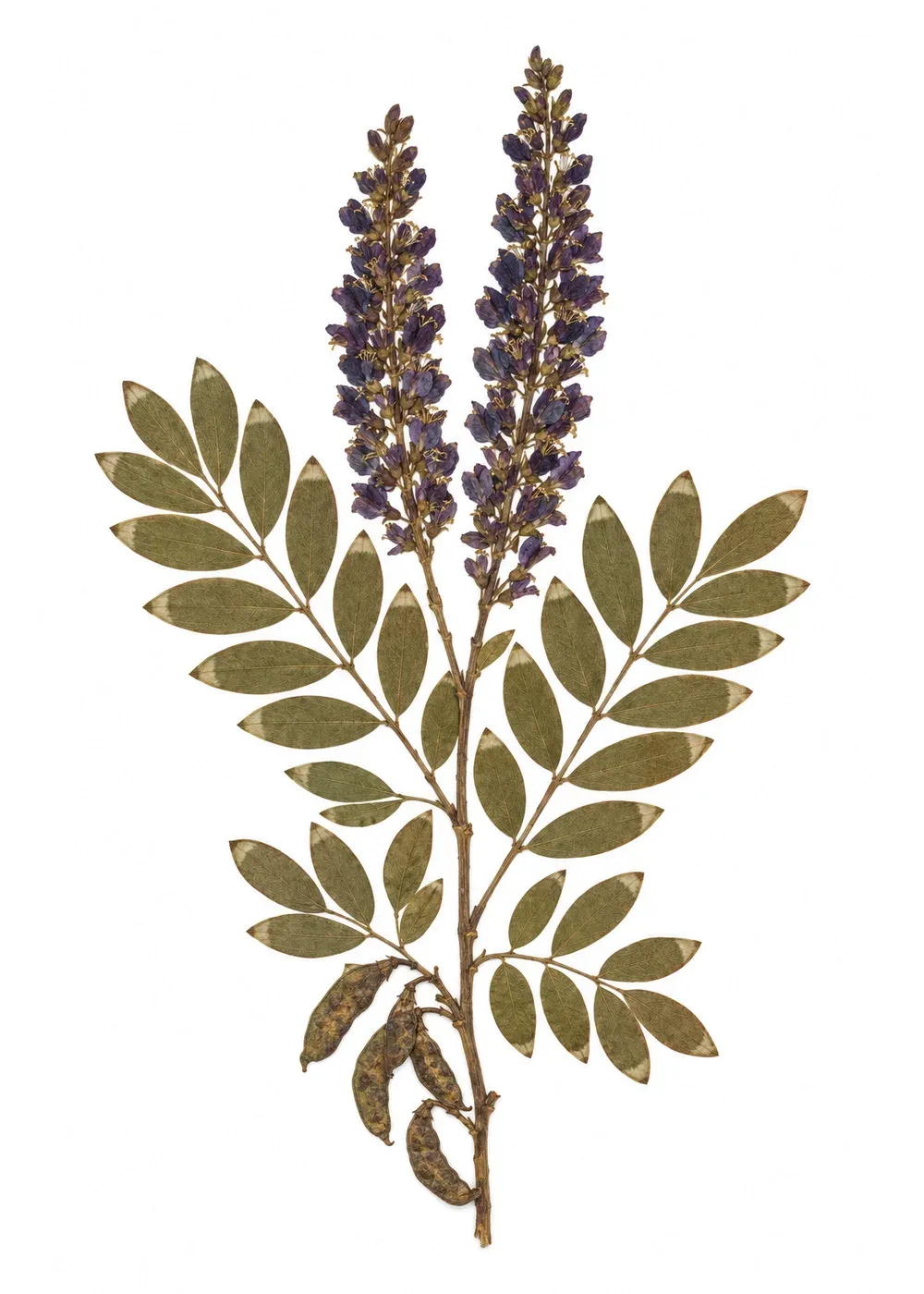
A false indigo pressed in 1915 keeps the sky over it at the average: 0.14 inches of rain a day at Yazoo City for seventy-six years.
Fire-Refusing Cane
Phyllostachys algida
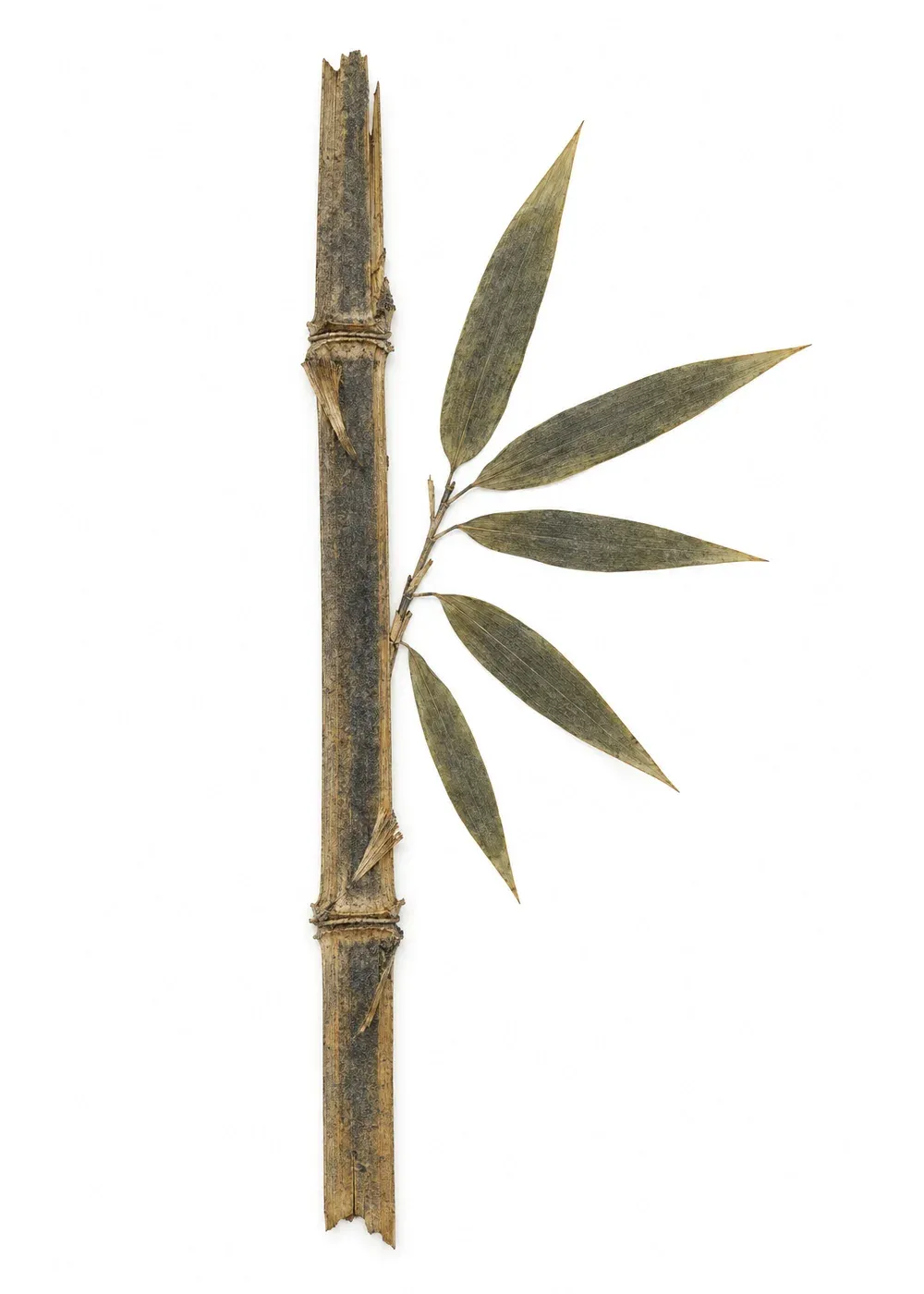
A pressed bamboo cane is why a Tangier loft burned for nine hours in 1898 and nothing in it got warmer than 21 °C.