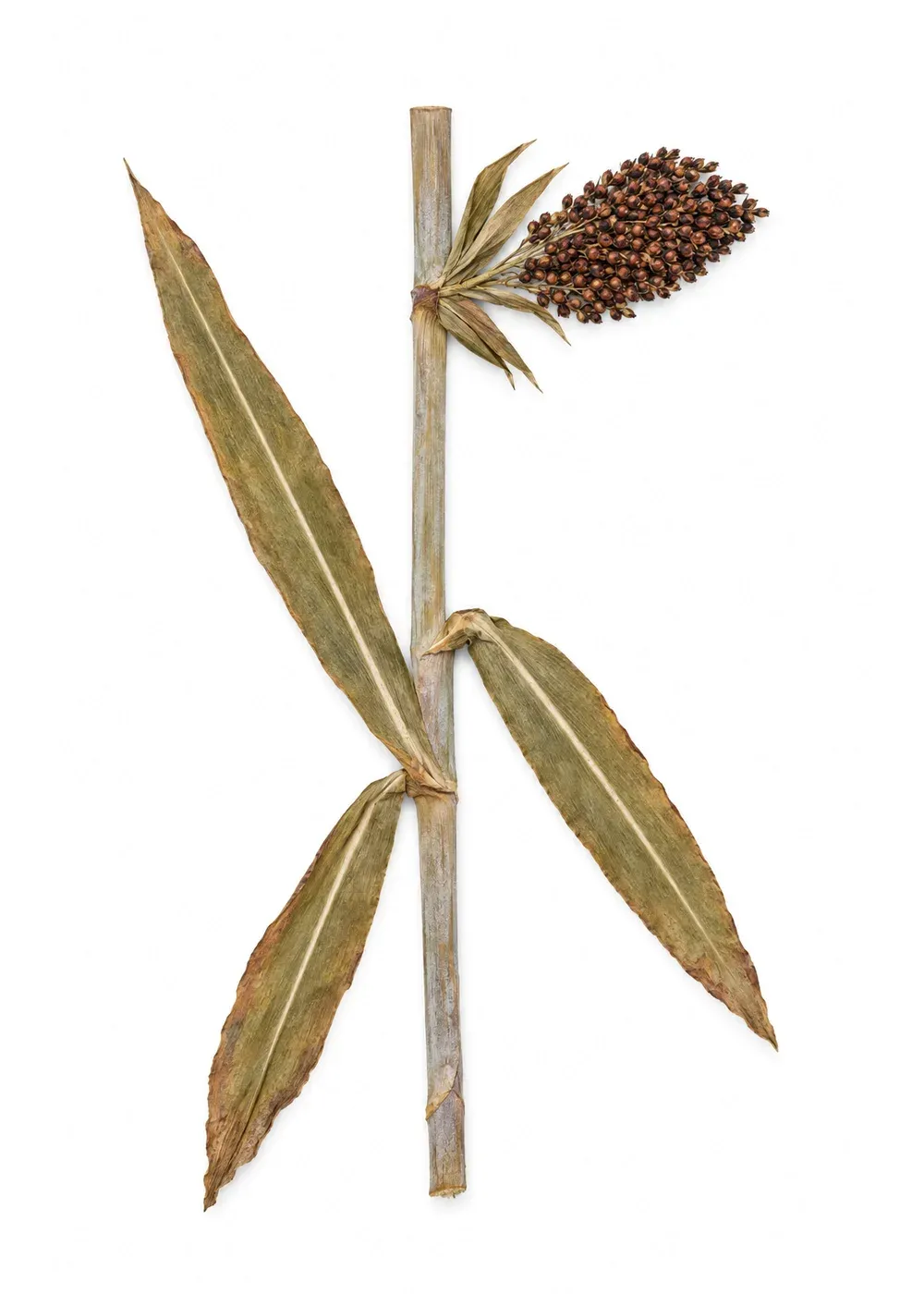
- No.
- G-0204
- Fam.
- Poaceae
- Loc.
- Karanganom, Klaten, Central Java
- Leg.
- Wahyu Santoso, land surveyor, July 2023
G-0204GlasshousePoaceae
Height-Mark Sorghum
Sorghum bicolor
Under cultivationA Javanese sorghum whose stalks stop at the exact height of any child who stands beside them, and once stopped for the night watchman.
- Collected at
- Karanganom, Klaten, Central Java
- Date
- July 2023
- Collector
- Wahyu Santoso, land surveyor
- Anomalies
- NumericalEmotional response
Sequenced fragment
CGGCGTCCGAGAAGGCGCCGCTGCTCCTCGGCGTCGCCTTAACACACGGTGAGCTAGCTTCGATCGGCCATGGACGTCAAGCTG
Contents 6 sections
Description
A red-grained Javanese landrace of sorghum, locally called cantel. The Glasshouse holds 31 stalks from six plants in a raised bed 2.4 m by 1.2 m. Mature stalks in the field reach 2.6–3.1 m. Stems are solid and pithy, sweet when cut, with a grey waxy bloom on the leaf sheaths. Leaves are alternate, 60–80 cm long and 6–8 cm wide, with a broad white midrib. The panicle is compact and oval, 18–25 cm long, with reddish-brown grains held in dark glumes.
Observations
When a child stands within about 30 cm of a growing stalk for twenty seconds or more, that stalk stops growing upward within the next forty minutes. Its final height, measured from the soil surface to the closed apex, matches the child’s standing height to within 1 mm. This has held across 21 recorded cases, for children aged three to eleven. Footwear is included in the measurement.
A stalk that has stopped never grows taller again. It keeps making leaves, which cluster below the apex, and it flowers and sets viable seed at the height where it stopped. Stopped stalks do not die back on the usual schedule. Each stalk stops only once, and a second child has no effect on it. Adults standing beside a stalk have no recorded effect.
The file
These are the questions visitors ask most often, taken from the book by the Glasshouse door and from the notes the day staff leave on my clipboard. I work 18:00 to 06:00, when there are no visitors, so I have had time to look the answers up. — L. Ashby, night watchman
Can my child stand next to it?
Yes, on Tuesday and Thursday mornings between 10:00 and 12:00, with a member of Glasshouse staff present. Shoes come off. The stalk measures whatever is standing there, so in shoes it will measure the shoes. Your child stands with their back to the stalk for a slow count of thirty, and within the hour the stalk stops. Staff tie a card on it with the child’s first name and the figure, and it stays at that height for good.
It is one child per stalk. There are 31 stalks in the bed and 22 have already stopped, so please ask at the desk before you promise anyone.
Adults can stand beside it as long as they like and nothing happens. The day staff have tried. So have I.
How do you know it’s exact?
Because the man who found it measures things for a living. In July 2023 Wahyu Santoso was surveying field boundaries outside Karanganom, in Klaten, when he noticed nine short stalks of cantel along the path to the primary school. Each was a different height, in a field where the rest stood well over his head. The children told him which stalk belonged to whom.
He set up his levelling staff and read all nine stalks. Then he measured the children against the same staff, barefoot. Every pair agreed to the millimetre. The school had no height chart on its wall, and the children didn’t need one. They went and stood by their own cantel and looked up to see how much they had grown since.
He sent us seed from the short stalks, along with his readings in a pencilled field book. The book is kept in the office. His handwriting is very neat.
Why doesn’t the short one have a card?
The short one is stalk 14. At 1,094 mm it is the shortest in the bed. It isn’t on the Tuesday list or the Thursday list. The day log says stopped overnight, no visitor recorded, which is true as far as it goes.
The Glasshouse is locked at 17:30, and there are no children in the building at night. There are 22 stopped stalks and 21 cards.
Why is there a sugar cube by the short one?
Because I put it there.
I stop in the Glasshouse at about 02:00 on my round, because it is the warmest room in the building, and I have my tea there. One night in March I stood with my back to stalk 14 while the kettle boiled in the office. I’m not sure why. I had been reading Mr Santoso’s field book. I am 1,781 mm in my socks. I checked that afterwards against the office doorframe with the steel tape.
In the morning, stalk 14 had stopped at 1,094 mm.
I rang my sister. She still lives in our mother’s house in Barnsley, and nobody has ever painted over the kitchen door. She measured the top line with her sewing tape, then again with a ruler, and rang me back. Mum used to give us a sugar cube for standing still, the paper-wrapped sort she brought home from the café where she worked. The canteen here has the same ones. I put one down every night, the ants have it by six, and I put down another.
The line on the kitchen door is at 1,094 mm. It is the last one with my name beside it. My sister’s go on for another eight years.
Genetic analysis
Leaf tissue was sequenced from stopped and unstopped stalks of the same plant. The genome is ordinary diploid Sorghum bicolor (2n = 20) from a red-grained Javanese landrace. The only difference is an eight-base stretch upstream of Dw3, the dwarfing gene that encodes an auxin efflux transporter and governs internode length in cultivated sorghum.
- In every unstopped stalk the stretch reads AAAAAAAA.
- In a stopped stalk it is rewritten in all tissue above the soil, and in no other stalk on that plant. Read in base four (A = 0, C = 1, G = 2, T = 3), it gives the stalk’s final height in millimetres.
- The fragment shown comes from stalk 14. It reads aacacacg, which is 1,094.
Seed from stopped stalks reverts to AAAAAAAA. Of the 22 stopped stalks, 21 match their cards exactly. Stalk 14 matches the figure in the day log.
Cultivation
The plants grow in a raised bed in the warm house at 26–32 °C by day, on a twelve-hour day length to imitate the Javanese dry season. The soil is a free-draining loam with grit, watered deeply once a week.
- The bed is not ratooned. Stopped stalks are never cut back. The oldest has been green since November 2023.
- New stalks for visiting children are sown each spring in a second bed and moved across at about 60 cm. Glasshouse staff wear no shoes in the bed and keep their own children out of it unless the children are on the list.
- Grain is harvested from stopped panicles and stored in labelled envelopes, one per child.
A packet of seed and a folding rule went back to the school in Karanganom at Mr Santoso’s request.
Effects
Families come back. On birthdays, parents stand the child beside their stalk again, and staff measure the gap above the apex with a folding rule and write it on the back of the card. Some cards now carry six figures. Children talk to their stalk, and several have asked for theirs to be watered first.
According to Mr Santoso, the school path in Karanganom had eleven new short stalks the following season. A teacher there has started copying the figures into the register.
The canteen reports that a box of paper-wrapped sugar cubes now lasts about a week less than it used to. No one has asked them to order more. They order more.
Filed alongside
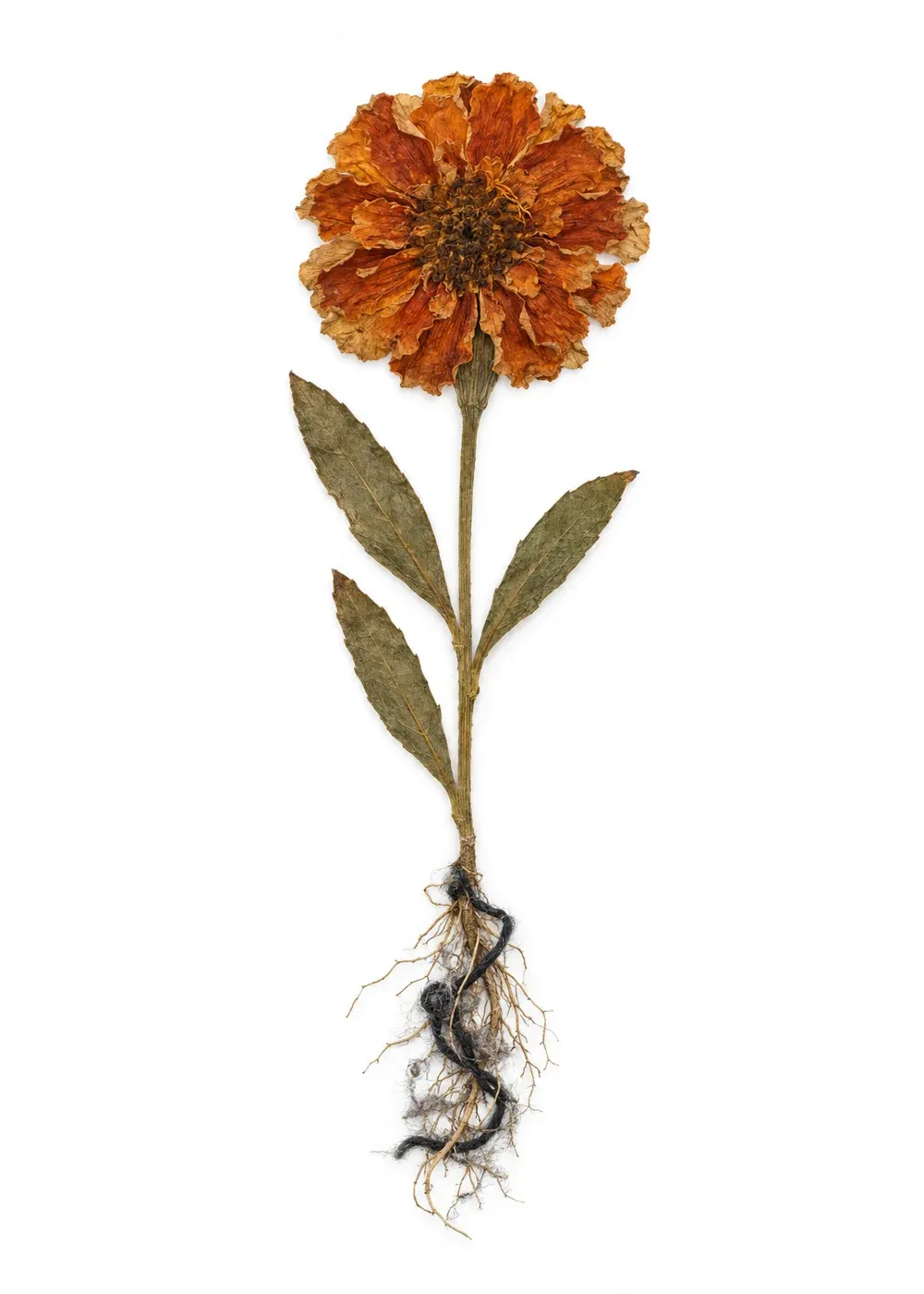
Funeral Laughter
Calendula hilarans
A marigold that sprouts only at funerals and makes the mourners remember something funny about the dead.
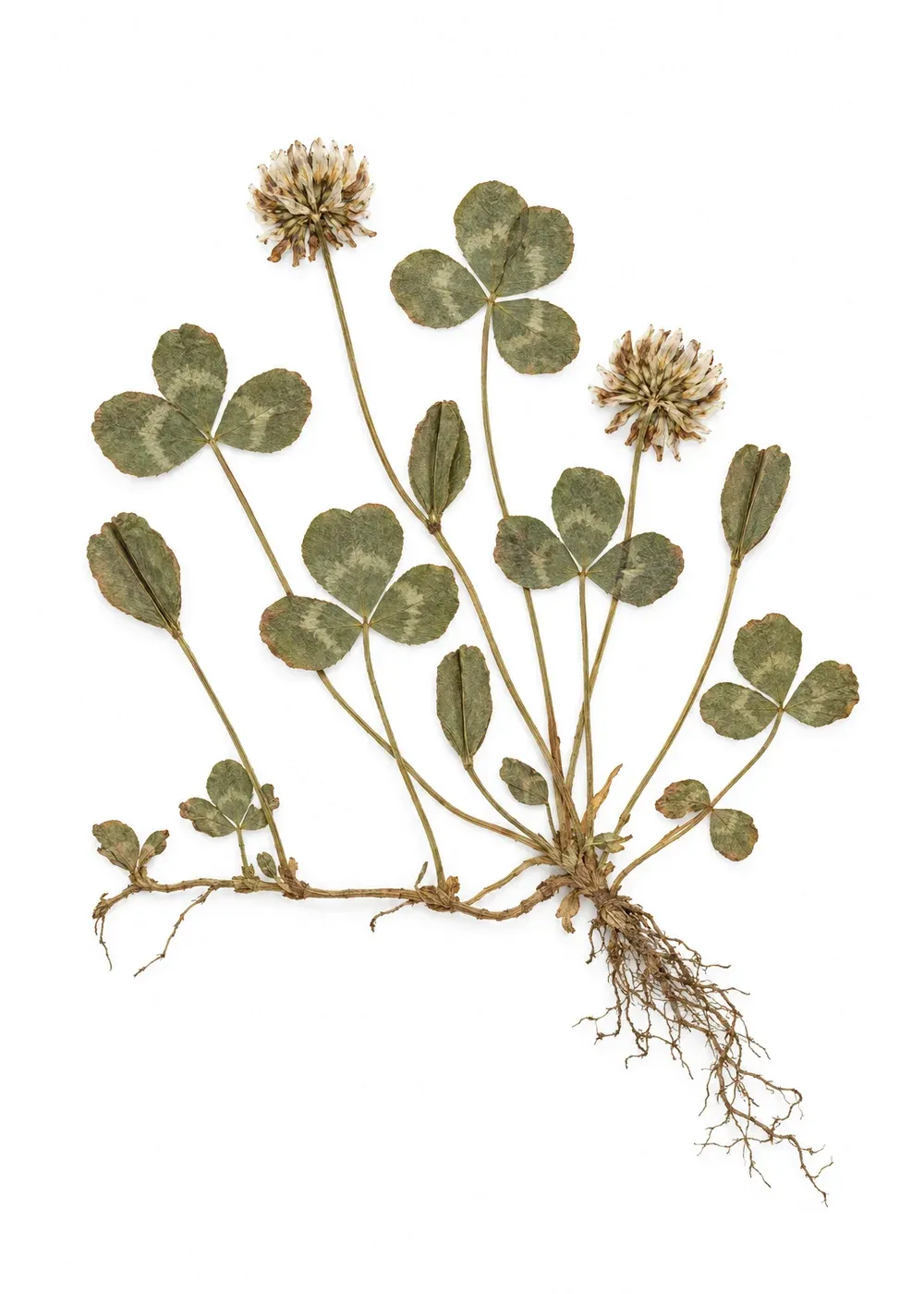
Sleeper's Clover
Trifolium somniferum
A clover that closes its leaves at the exact moment anyone in the building falls asleep, and opens them for dreams that go well.
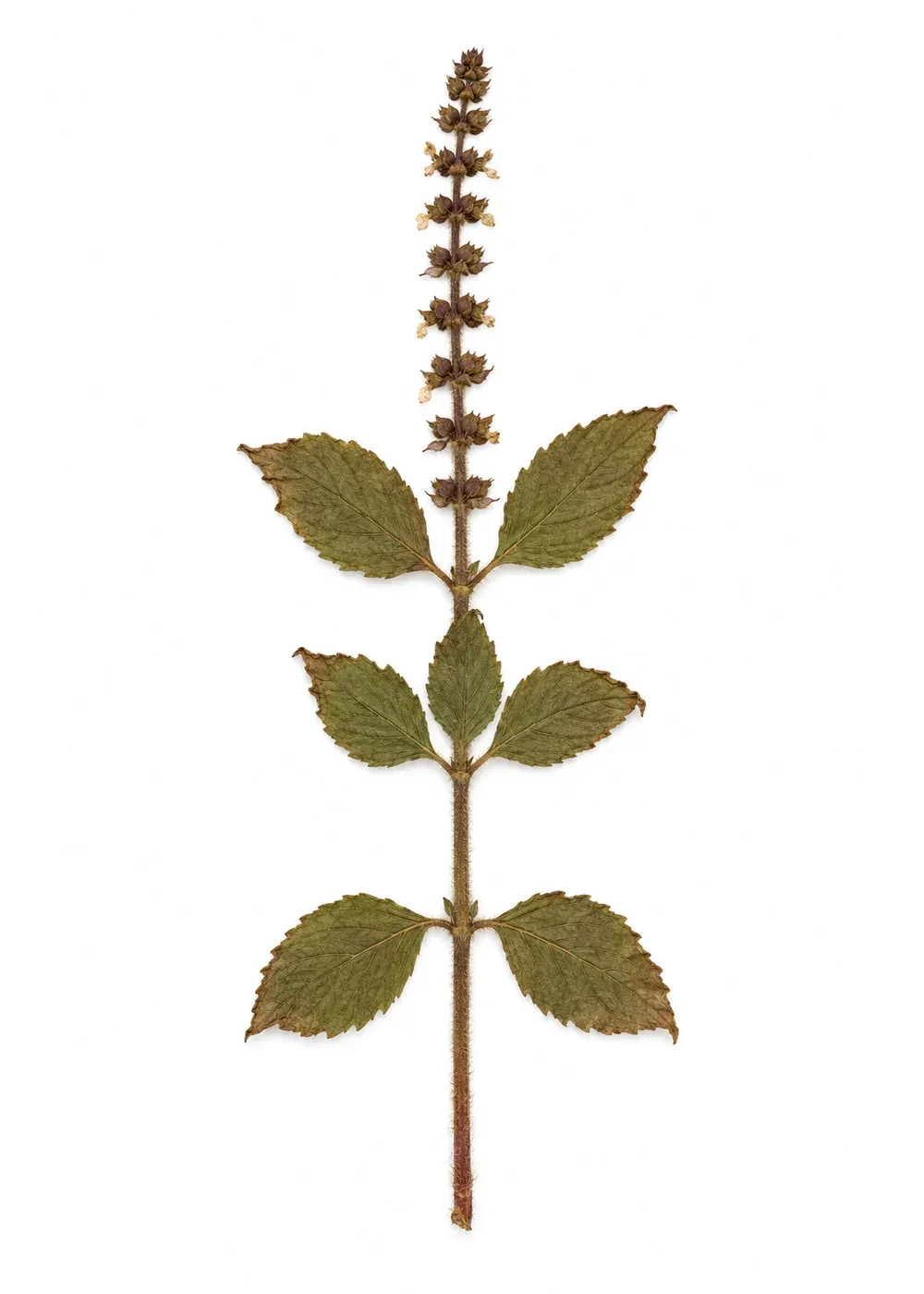
Extra Place Basil
Ocimum gratissimum
A fokontany-office basil from Toamasina adds one name to every list made beside it: a living person no register has ever recorded.